

I am a Research Scientist at the London Research Center of Noah’s Ark Lab. My research focuses on AI for materials science, with an emphasis on developing algorithms for crystallography and spectroscopy using graph representation learning and Bayesian optimization.
My research interest in this area has been shaped through a combination of interdisciplinary training and research experience across academia and industry. I received my Ph.D. from The Hong Kong University of Science and Technology (Guangzhou Campus), where I worked with Prof. Tong-Yi Zhang. During my Ph.D., I was also a visiting student at City University of Hong Kong, working with Prof. Yang Ren, and gained industry research experience through internships at Shanghai AI Lab, GreenDynamics and AI Lab, The Yangtze River Delta.
Prior to my Ph.D., I obtained an MPhil in Mechanics from Shanghai University under the supervision of Prof. Tong-Yi Zhang, where I worked on transfer learning for materials science during an internship at Zhejiang Laboratory. I received my BEng in Chemical Machinery from Beijing University of Chemical Technology, with a focus on finite element methods and chemistry.
I have developed a series of machine learning methods for key problems in X-ray diffraction (XRD) and crystal analysis, including large-scale XRD pattern simulation (SimXRD), crystal structure determination (XQueryer for single-phase analysis and XDecomposer for multiphase decomposition), XRD pattern refinement (WPEM), and crystal property prediction (PRDNet). In addition, I developed one of the first Bayesian optimization frameworks for materials discovery, Bgolearn, which has been selected for support under the Open Source Project Program of the Shanghai Municipal Commission of Economy and Informatization.
Outside of research, I enjoy jogging and going to the gym.
I serve as a reviewer for ICLR, NeurIPS, ICML, AAAI, KDD, and journals EAAI , Communications Materials , Results in Engineering, MGE Advances .
Education
-
 The Hong Kong University of Science and Technology (Guangzhou)Ph.D. in AMATSep. 2023 - May. 2026
 -
 City University of Hong KongDepartment of Physics
Visiting Research StudentJun. 2025 - Dec. 2025 -
 Shanghai UniversityMPhil in MechanicsSep. 2020 - Jun. 2023
 -
 Beijing University of Chemical TechnologyB.S. in Chemical MachinerySep. 2016 - Jun. 2020
Experience
-
 AI Lab, The Yangtze River DeltaScientist(internship)July. 2026 - Sep 2026
 -
 GreenDynamicsMTS InternMay. 2026 - June 2026
 -
 Shanghai AI LabResearch InternJan. 2026 - Apr. 2026
 -
 Zhejiang LabResearch InternMar. 2023 - Sep. 2023
Honors & Awards
-
Outstanding Young Academic Presentation Award (CMC)2024
-
Outstanding Graduate of Shanghai University2023
-
China National Scholarship2022
News
Apps

白泽BaiZe
BaiZe is an AI Agent designed specifically for materials science research. It supports the full research workflow, from literature discovery and evidence synthesis to hypothesis generation, experimental design, and scientific writing. Rather than simply generating answers, BaiZe organizes scientific reasoning into a traceable and reproducible workflow, helping researchers transform open-ended materials questions into testable hypotheses and actionable experiments. It is open-source and local-first, allowing research outputs such as literature notes, hypotheses, experimental protocols, and papers to be retained and further developed within a project.
白泽BaiZe
BaiZe is an AI Agent designed specifically for materials science research. It supports the full research workflow, from literature discovery and evidence synthesis to hypothesis generation, experimental design, and scientific writing. Rather than simply generating answers, BaiZe organizes scientific reasoning into a traceable and reproducible workflow, helping researchers transform open-ended materials questions into testable hypotheses and actionable experiments. It is open-source and local-first, allowing research outputs such as literature notes, hypotheses, experimental protocols, and papers to be retained and further developed within a project.

PlotEverything
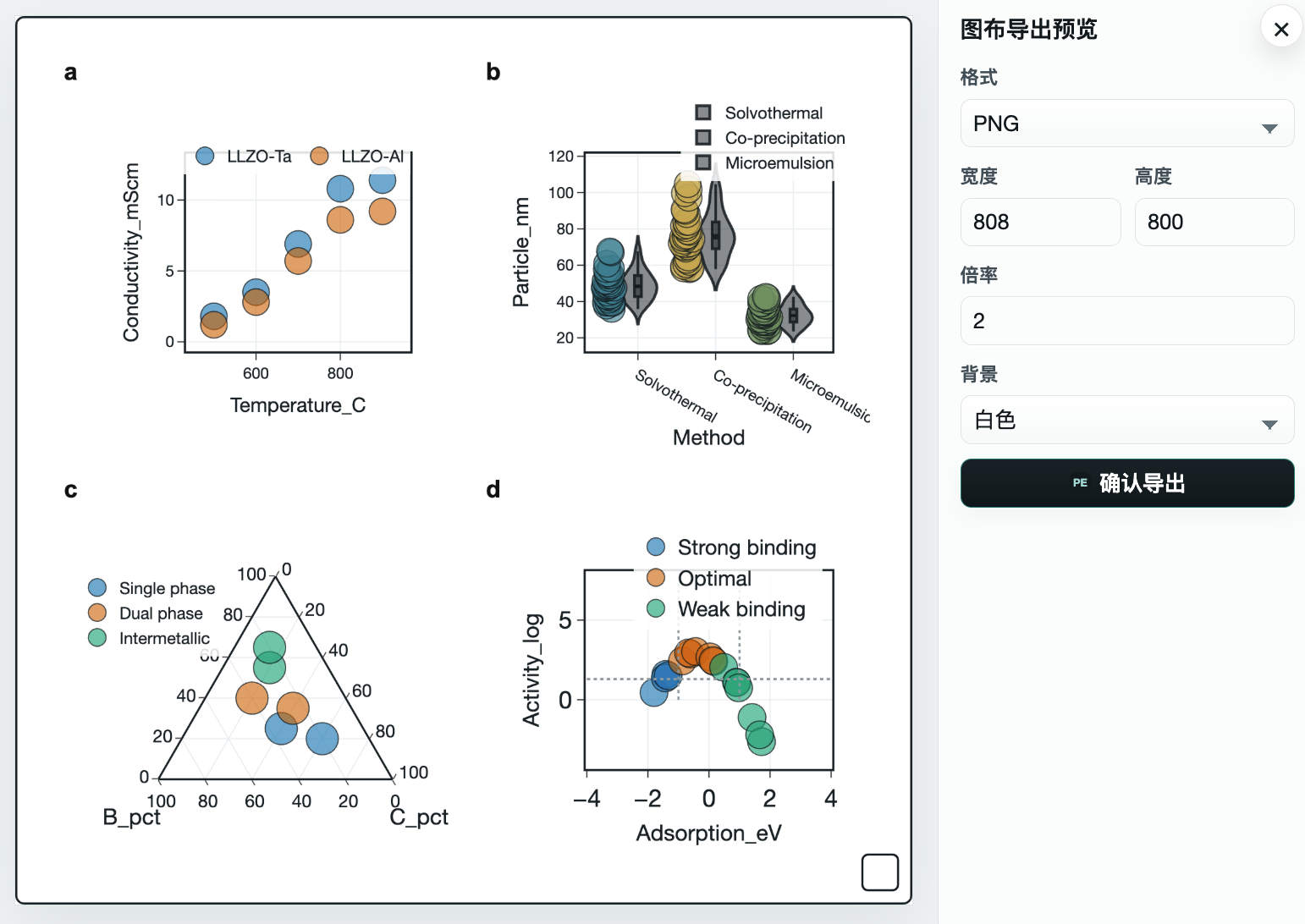
PlotEverything is a lightweight scientific figure workspace. It helps users create publication-style figures from spreadsheet data, display crystal structures, simulate XRD patterns, arrange multi-panel figures, and export final images without writing plotting code.
PlotEverything
PlotEverything is a lightweight scientific figure workspace. It helps users create publication-style figures from spreadsheet data, display crystal structures, simulate XRD patterns, arrange multi-panel figures, and export final images without writing plotting code.
XMatcher
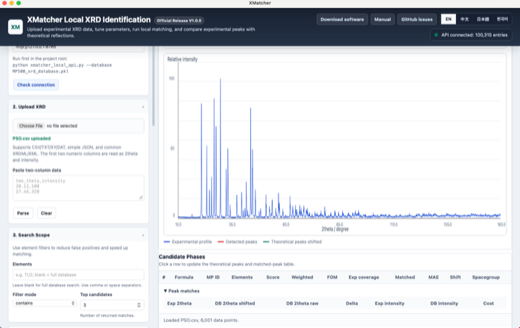
XMatcher is a app toolkit for experimental X-ray diffraction (XRD) phase matching against precomputed crystal-structure databases. It is designed around a production workflow: build a searchable theoretical peak database once, then perform fast and explainable retrieval for experimental patterns.
XMatcher
XMatcher is a app toolkit for experimental X-ray diffraction (XRD) phase matching against precomputed crystal-structure databases. It is designed around a production workflow: build a searchable theoretical peak database once, then perform fast and explainable retrieval for experimental patterns.

Selected Publications (view all )
High-strength and ductile high-entropy alloy via expert-trajectory-guided processingn
High-Entropy Alloy Trajectory Machine Learning Optimization ATON model
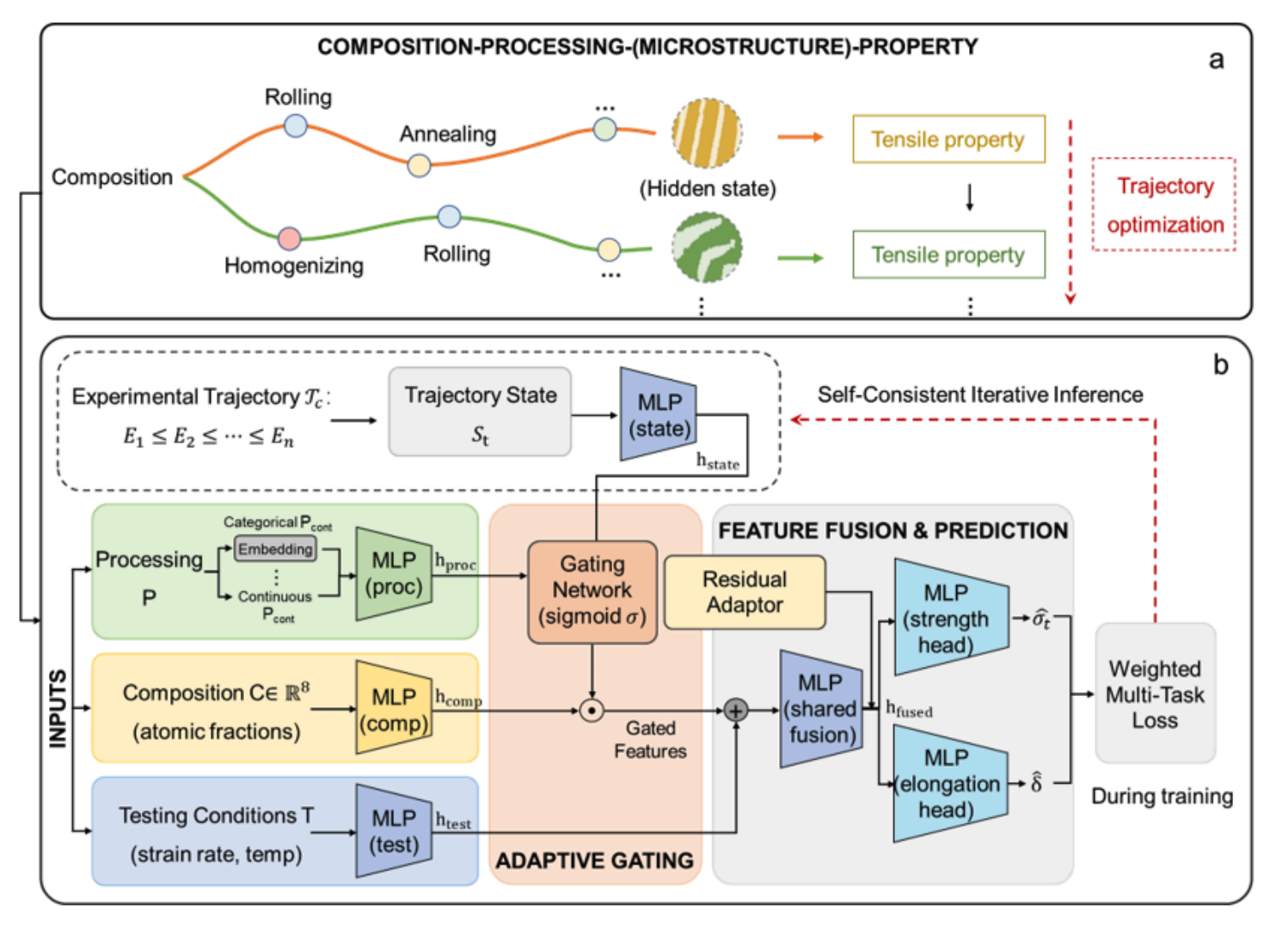
Overcoming the strength-ductility trade-off remains a central challenge in structural materials. Here we report an optimized thermomechanical-processing state of AlCoCrFeNi2.5 high-entropy alloy, identified with the assistance of an alloy trajectory optimization network. The optimized alloy exhibits an exceptional combination of a yield strength of 1.6 GPa, an ultimate tensile strength of 1.8 GPa, and a large fracture elongation of 20% at room temperature. At 650 oC, it retains a yield strength of 1.2 GPa, an ultimate tensile strength of 1.4 GPa, and a fracture elongation of 14%. The unprecedented mechanical properties originate from a unique heterogeneous microstructure consisting of spindle-shaped FCC domains, fine lamellar regions, and recrystallized dual-phase regions. This architecture enables cooperative deformation among ductile domains, strengthening lamellae and recrystallized dual-phase regions, thereby promoting appropriate strain partitioning, sustained work hardening and delayed damage localization. These results demonstrate that thermomechanical-processing optimization can transform the complex eutectic architecture into a mechanically cooperative microstructural state with superior strength, ductility, and intermediate-temperature resistance.
High-strength and ductile high-entropy alloy via expert-trajectory-guided processingn
High-Entropy Alloy Trajectory Machine Learning Optimization ATON model
Overcoming the strength-ductility trade-off remains a central challenge in structural materials. Here we report an optimized thermomechanical-processing state of AlCoCrFeNi2.5 high-entropy alloy, identified with the assistance of an alloy trajectory optimization network. The optimized alloy exhibits an exceptional combination of a yield strength of 1.6 GPa, an ultimate tensile strength of 1.8 GPa, and a large fracture elongation of 20% at room temperature. At 650 oC, it retains a yield strength of 1.2 GPa, an ultimate tensile strength of 1.4 GPa, and a fracture elongation of 14%. The unprecedented mechanical properties originate from a unique heterogeneous microstructure consisting of spindle-shaped FCC domains, fine lamellar regions, and recrystallized dual-phase regions. This architecture enables cooperative deformation among ductile domains, strengthening lamellae and recrystallized dual-phase regions, thereby promoting appropriate strain partitioning, sustained work hardening and delayed damage localization. These results demonstrate that thermomechanical-processing optimization can transform the complex eutectic architecture into a mechanically cooperative microstructural state with superior strength, ductility, and intermediate-temperature resistance.
XMatcher: An Open-Source Framework for X-Ray Diffraction Phase Identification
Powder X-Ray Diffraction Phase Identification Search-Match Multiphase Analysis
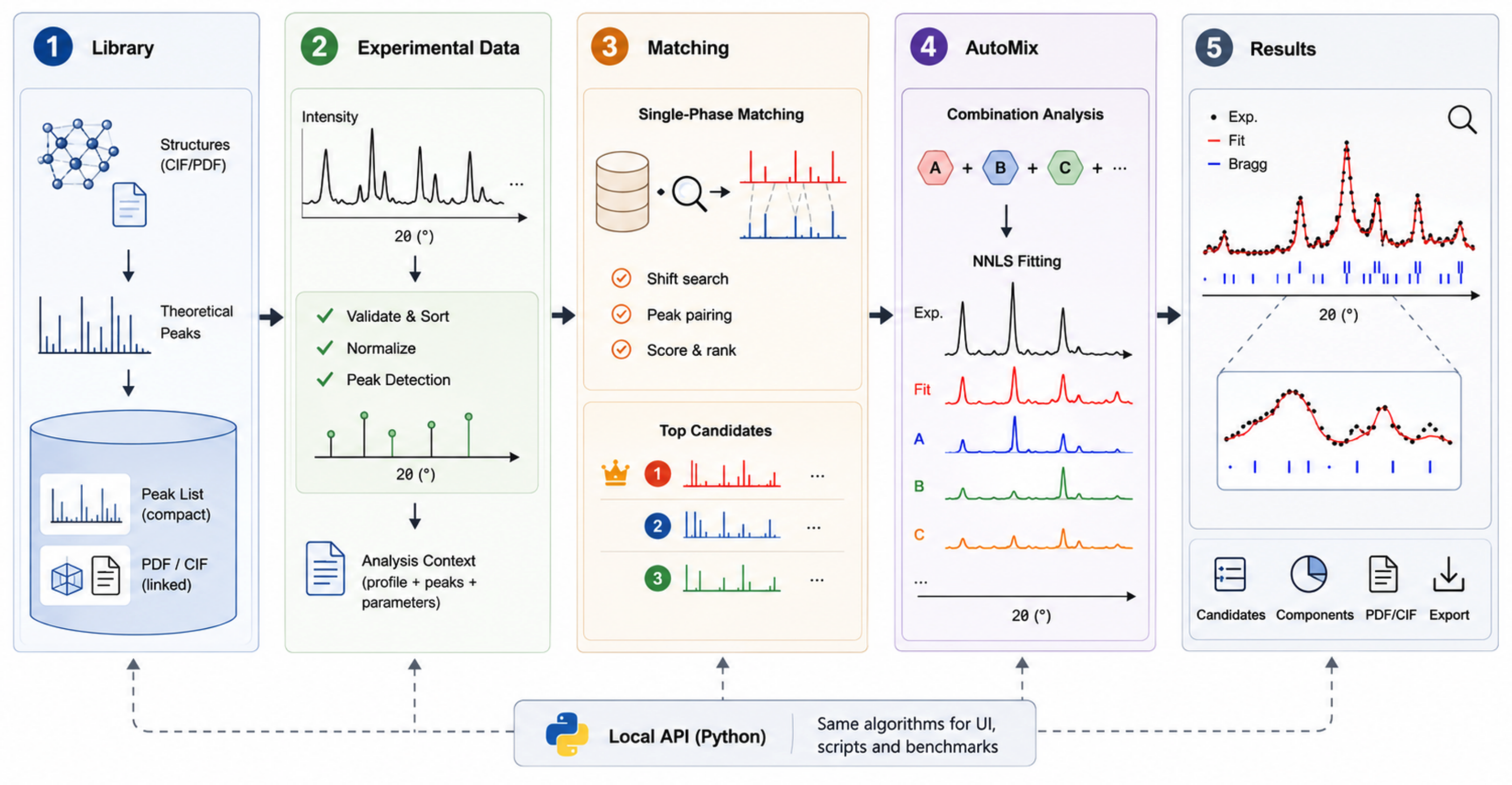
Powder X-ray diffraction (XRD) is widely used for crystalline phase identification, and recent machine learning approaches have demonstrated remarkable capabilities in accelerating diffraction interpretation. However, reliable phase assignment still requires transparent, evidence-based validation, particularly for complex samples where interpretability and expert assessment remain essential. Search-match methods provide a robust and complementary strategy, yet many implementations are proprietary, limiting accessibility and reproducibility. Here, we introduce XMatcher, an open-source, evidence-driven framework that integrates diffraction databases, matching algorithms, and interactive visualization into a portable workflow. XMatcher generates theoretical diffraction libraries from crystal structures, retrieves candidate phases through chemical and diffraction constraints, applies global angular-shift correction and one-to-one peak matching, and reports quantitative agreement metrics together with peak-level evidence. Its AutoMix module extends identification to multiphase patterns by evaluating candidate phase combinations, estimating non-negative diffraction contributions, and visualizing phase-specific peak distributions. Through a local graphical interface, XMatcher enables ranked candidate inspection, interactive pattern comparison, PDF/CIF-based whole-pattern validation, and reproducible analysis export. By exposing both supporting and conflicting evidence rather than relying on a single similarity score, XMatcher provides an interpretable and reproducible platform for crystalline phase identification.
XMatcher: An Open-Source Framework for X-Ray Diffraction Phase Identification
Powder X-Ray Diffraction Phase Identification Search-Match Multiphase Analysis
Powder X-ray diffraction (XRD) is widely used for crystalline phase identification, and recent machine learning approaches have demonstrated remarkable capabilities in accelerating diffraction interpretation. However, reliable phase assignment still requires transparent, evidence-based validation, particularly for complex samples where interpretability and expert assessment remain essential. Search-match methods provide a robust and complementary strategy, yet many implementations are proprietary, limiting accessibility and reproducibility. Here, we introduce XMatcher, an open-source, evidence-driven framework that integrates diffraction databases, matching algorithms, and interactive visualization into a portable workflow. XMatcher generates theoretical diffraction libraries from crystal structures, retrieves candidate phases through chemical and diffraction constraints, applies global angular-shift correction and one-to-one peak matching, and reports quantitative agreement metrics together with peak-level evidence. Its AutoMix module extends identification to multiphase patterns by evaluating candidate phase combinations, estimating non-negative diffraction contributions, and visualizing phase-specific peak distributions. Through a local graphical interface, XMatcher enables ranked candidate inspection, interactive pattern comparison, PDF/CIF-based whole-pattern validation, and reproducible analysis export. By exposing both supporting and conflicting evidence rather than relying on a single similarity score, XMatcher provides an interpretable and reproducible platform for crystalline phase identification.
SVGym (SciVerseGym): An Environment for Reinforcement Learning and Bayesian Optimization in Crystal Discovery
SciVerseGym SVGym reinforcement learning Bayesian optimization crystal discovery Gymnasium environment
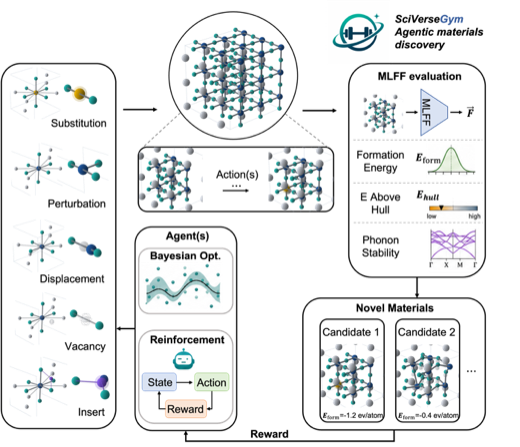
We introduce SciVerseGym, a Gymnasium-compatible environment for sequential crystal discovery that frames crystal design as a Markov decision process. Agents observe an atomistic structure, apply chemically meaningful edits, and receive feedback from a configurable evaluator. SciVerseGym supports local and global actions, including elemental substitution, lattice perturbation, atomic displacement, vacancy creation, and atom insertion, along with configurable chemical spaces, structure pools, atomistic and graph-based observations, custom rewards, optional relaxation, and stability or phonon-related diagnostics. Each step applies an edit, evaluates the candidate using a machine-learned interatomic potential or any ASE-compatible calculator, and returns the standard (obs, reward, terminated, truncated, info) tuple. By decoupling agent logic from materials infrastructure, SciVerseGym provides an open, reproducible, and extensible testbed for reinforcement learning, Bayesian optimization, evolutionary search, and language-agent workflows in closed-loop crystal discovery.
SVGym (SciVerseGym): An Environment for Reinforcement Learning and Bayesian Optimization in Crystal Discovery
SciVerseGym SVGym reinforcement learning Bayesian optimization crystal discovery Gymnasium environment
We introduce SciVerseGym, a Gymnasium-compatible environment for sequential crystal discovery that frames crystal design as a Markov decision process. Agents observe an atomistic structure, apply chemically meaningful edits, and receive feedback from a configurable evaluator. SciVerseGym supports local and global actions, including elemental substitution, lattice perturbation, atomic displacement, vacancy creation, and atom insertion, along with configurable chemical spaces, structure pools, atomistic and graph-based observations, custom rewards, optional relaxation, and stability or phonon-related diagnostics. Each step applies an edit, evaluates the candidate using a machine-learned interatomic potential or any ASE-compatible calculator, and returns the standard (obs, reward, terminated, truncated, info) tuple. By decoupling agent logic from materials infrastructure, SciVerseGym provides an open, reproducible, and extensible testbed for reinforcement learning, Bayesian optimization, evolutionary search, and language-agent workflows in closed-loop crystal discovery.
Physics-Constrained Learning of Crystal Structures and Properties from Powder Diffraction
physics-constrained learning powder X-ray diffraction crystal structure inference crystal property prediction XQueryer WPEM PRDNet
This thesis develops a physics-constrained AI framework for crystal structure and property inference from powder X-ray diffraction (PXRD). By combining large-scale simulated and experimental datasets, physics-aware structure identification (XQueryer), whole-pattern refinement (WPEM), and diffraction-informed representation learning (PRDNet), the framework enables end-to-end, physically consistent interpretation of diffraction data, advancing autonomous materials characterization and AI-driven materials discovery.
Physics-Constrained Learning of Crystal Structures and Properties from Powder Diffraction
physics-constrained learning powder X-ray diffraction crystal structure inference crystal property prediction XQueryer WPEM PRDNet
This thesis develops a physics-constrained AI framework for crystal structure and property inference from powder X-ray diffraction (PXRD). By combining large-scale simulated and experimental datasets, physics-aware structure identification (XQueryer), whole-pattern refinement (WPEM), and diffraction-informed representation learning (PRDNet), the framework enables end-to-end, physically consistent interpretation of diffraction data, advancing autonomous materials characterization and AI-driven materials discovery.
XDecomposer: Learning Prior-Free Set Decomposition for Multiphase X-ray Diffraction
XDecomposer multiphase XRD set decomposition phase identification powder diffraction source separation
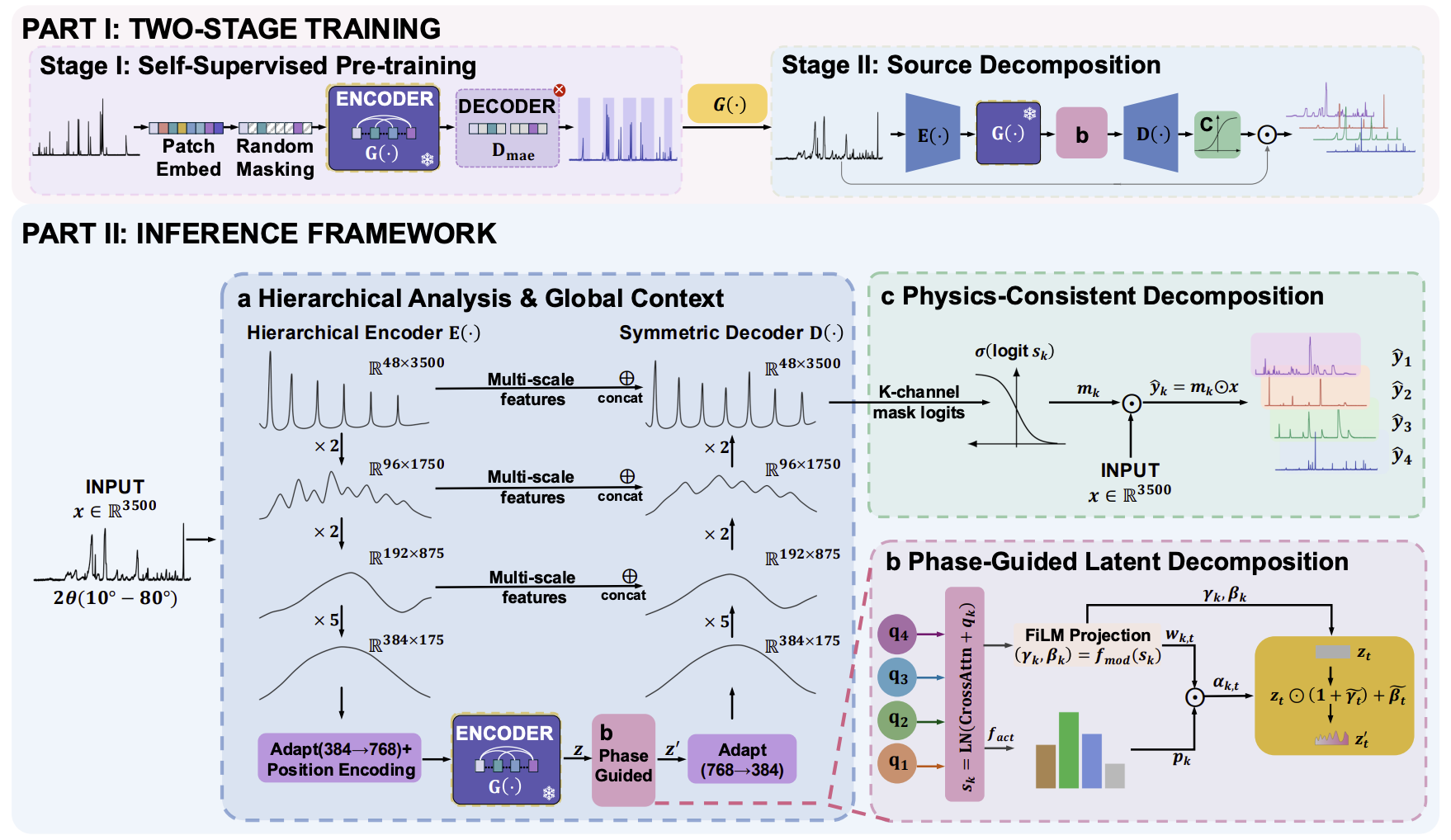
Multiphase powder X-ray diffraction (PXRD) analysis remains a fundamental bottleneck in structure identification, as real-world synthesis often produces complex mixtures whose constituent phases (components) cannot be reliably disentangled. While recent advances in representation-based crystal retrieval and generation suggest the possibility of inferring structures directly from PXRD, existing approaches largely assume single-phase inputs and break down in multiphase settings. Here, we present XDecomposer, a prior-free framework for joint decomposition and identification of multiphase XRD patterns without requiring candidate phase lists, structural templates, or prior knowledge of phase number. We formulate multiphase diffraction analysis as a set prediction problem, where the model infers an unordered set of phase-resolved components, their mixture proportions, and corresponding structural representations within a unified architecture. A phase-query-driven decomposition mechanism, together with diffraction-consistent physical reconstruction, enables accurate source separation while preserving crystallographic fidelity. Extensive experiments on both simulated and experimental datasets show that XDecomposer substantially improves reconstruction accuracy and phase identification across diverse chemical systems, while maintaining strong generalization to unseen mixtures. These results provide a practical route toward data-driven, source-resolved multiphase XRD analysis and reduce long-standing dependence on prior-guided iteratively phase matching.
XDecomposer: Learning Prior-Free Set Decomposition for Multiphase X-ray Diffraction
XDecomposer multiphase XRD set decomposition phase identification powder diffraction source separation
Multiphase powder X-ray diffraction (PXRD) analysis remains a fundamental bottleneck in structure identification, as real-world synthesis often produces complex mixtures whose constituent phases (components) cannot be reliably disentangled. While recent advances in representation-based crystal retrieval and generation suggest the possibility of inferring structures directly from PXRD, existing approaches largely assume single-phase inputs and break down in multiphase settings. Here, we present XDecomposer, a prior-free framework for joint decomposition and identification of multiphase XRD patterns without requiring candidate phase lists, structural templates, or prior knowledge of phase number. We formulate multiphase diffraction analysis as a set prediction problem, where the model infers an unordered set of phase-resolved components, their mixture proportions, and corresponding structural representations within a unified architecture. A phase-query-driven decomposition mechanism, together with diffraction-consistent physical reconstruction, enables accurate source separation while preserving crystallographic fidelity. Extensive experiments on both simulated and experimental datasets show that XDecomposer substantially improves reconstruction accuracy and phase identification across diverse chemical systems, while maintaining strong generalization to unseen mixtures. These results provide a practical route toward data-driven, source-resolved multiphase XRD analysis and reduce long-standing dependence on prior-guided iteratively phase matching.

Efficient and Principled Scientific Discovery through Bayesian Optimization: A Tutorial
Bayesian optimization scientific discovery tutorial surrogate models acquisition functions materials discovery
Traditional materials discovery relies on iterative hypothesis–experiment cycles, but it scales poorly with increasing complexity: problems with 5–15 design variables and costly, time-intensive experiments often allow exploration of less than 0.1% of the design space. This tutorial introduces Bayesian Optimization (BO) as a principled framework to accelerate discovery by using surrogate models, such as Gaussian processes, and acquisition functions to efficiently balance exploration and exploitation. We present the core components, practical workflows, and real-world applications of BO in areas like catalysis and molecular discovery, along with key extensions for realistic settings. Overall, this tutorial bridges theory and practice, enabling more efficient, informed, and scalable scientific discovery.
Efficient and Principled Scientific Discovery through Bayesian Optimization: A Tutorial
Bayesian optimization scientific discovery tutorial surrogate models acquisition functions materials discovery
Traditional materials discovery relies on iterative hypothesis–experiment cycles, but it scales poorly with increasing complexity: problems with 5–15 design variables and costly, time-intensive experiments often allow exploration of less than 0.1% of the design space. This tutorial introduces Bayesian Optimization (BO) as a principled framework to accelerate discovery by using surrogate models, such as Gaussian processes, and acquisition functions to efficiently balance exploration and exploitation. We present the core components, practical workflows, and real-world applications of BO in areas like catalysis and molecular discovery, along with key extensions for realistic settings. Overall, this tutorial bridges theory and practice, enabling more efficient, informed, and scalable scientific discovery.
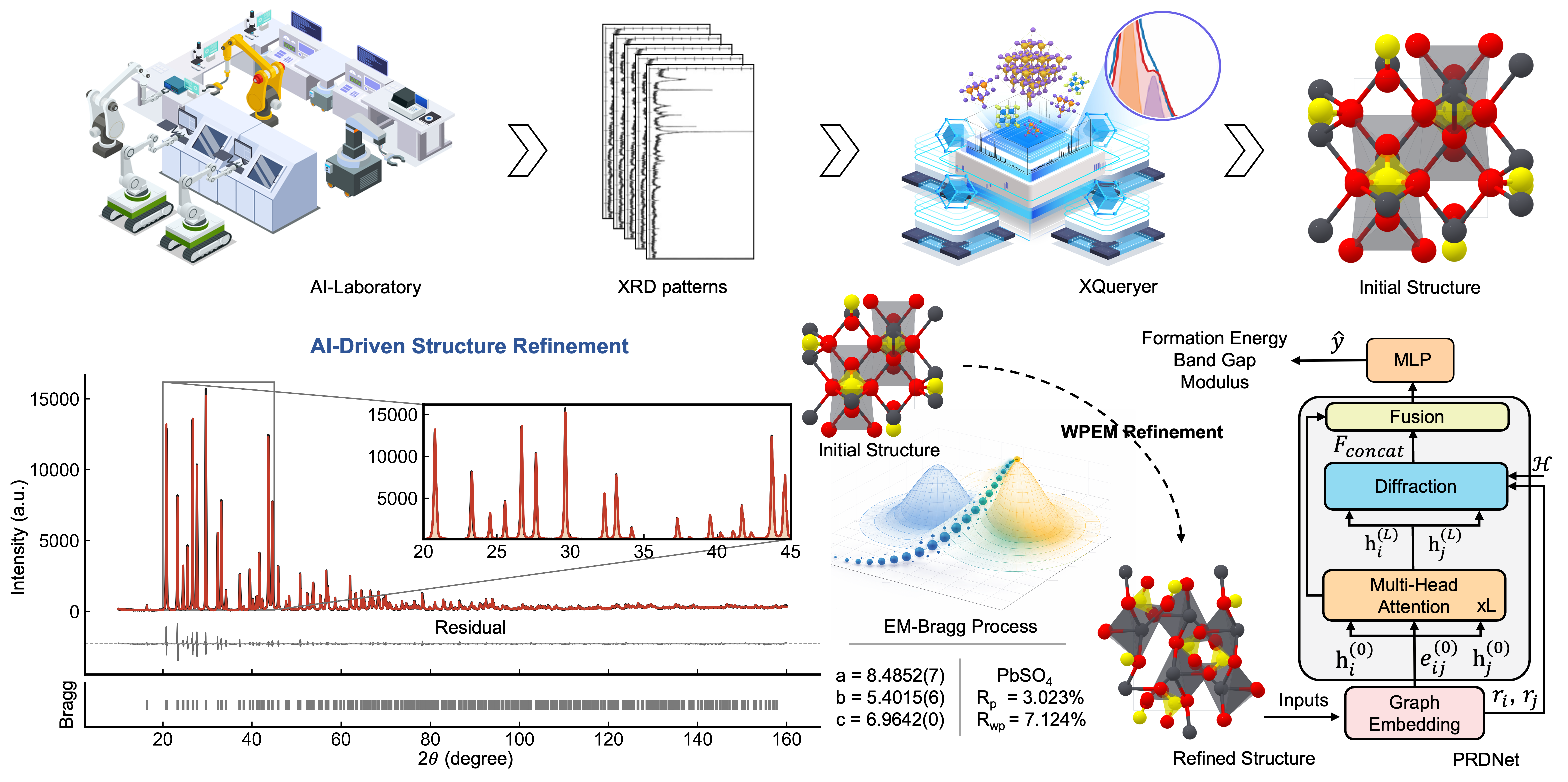
AI-Driven Structure Refinement of X-ray Diffraction
WPEM X-ray diffraction refinement whole-pattern decomposition Bragg law structure refinement multiphase XRD
AI can quickly propose candidate phases from X-ray diffraction (XRD), but refinement often fails due to unstable intensities under peak overlap and weak diffraction constraints. We introduce WPEM, a physics-constrained whole-pattern decomposition workflow that embeds Bragg's law in a batch expectation–maximization framework. WPEM models the full profile as a probabilistic mixture, iteratively inferring component intensities while keeping peak centers Bragg-consistent, producing a stable, physically valid representation. On \ce{PbSO4} and \ce{Tb2BaCoO5}, WPEM outperforms FullProf and TOPAS. It generalizes to multiphase Ti–15Nb films, \ce{NaCl}–\ce{Li2CO3} mixtures, semicrystalline polymers, operando cathodes, disordered Ru–Mn oxides (CCDC 2530452), and ancient Egyptian make-up, bridging AI-generated hypotheses and diffraction-ready structure refinement.
AI-Driven Structure Refinement of X-ray Diffraction
WPEM X-ray diffraction refinement whole-pattern decomposition Bragg law structure refinement multiphase XRD
AI can quickly propose candidate phases from X-ray diffraction (XRD), but refinement often fails due to unstable intensities under peak overlap and weak diffraction constraints. We introduce WPEM, a physics-constrained whole-pattern decomposition workflow that embeds Bragg's law in a batch expectation–maximization framework. WPEM models the full profile as a probabilistic mixture, iteratively inferring component intensities while keeping peak centers Bragg-consistent, producing a stable, physically valid representation. On \ce{PbSO4} and \ce{Tb2BaCoO5}, WPEM outperforms FullProf and TOPAS. It generalizes to multiphase Ti–15Nb films, \ce{NaCl}–\ce{Li2CO3} mixtures, semicrystalline polymers, operando cathodes, disordered Ru–Mn oxides (CCDC 2530452), and ancient Egyptian make-up, bridging AI-generated hypotheses and diffraction-ready structure refinement.
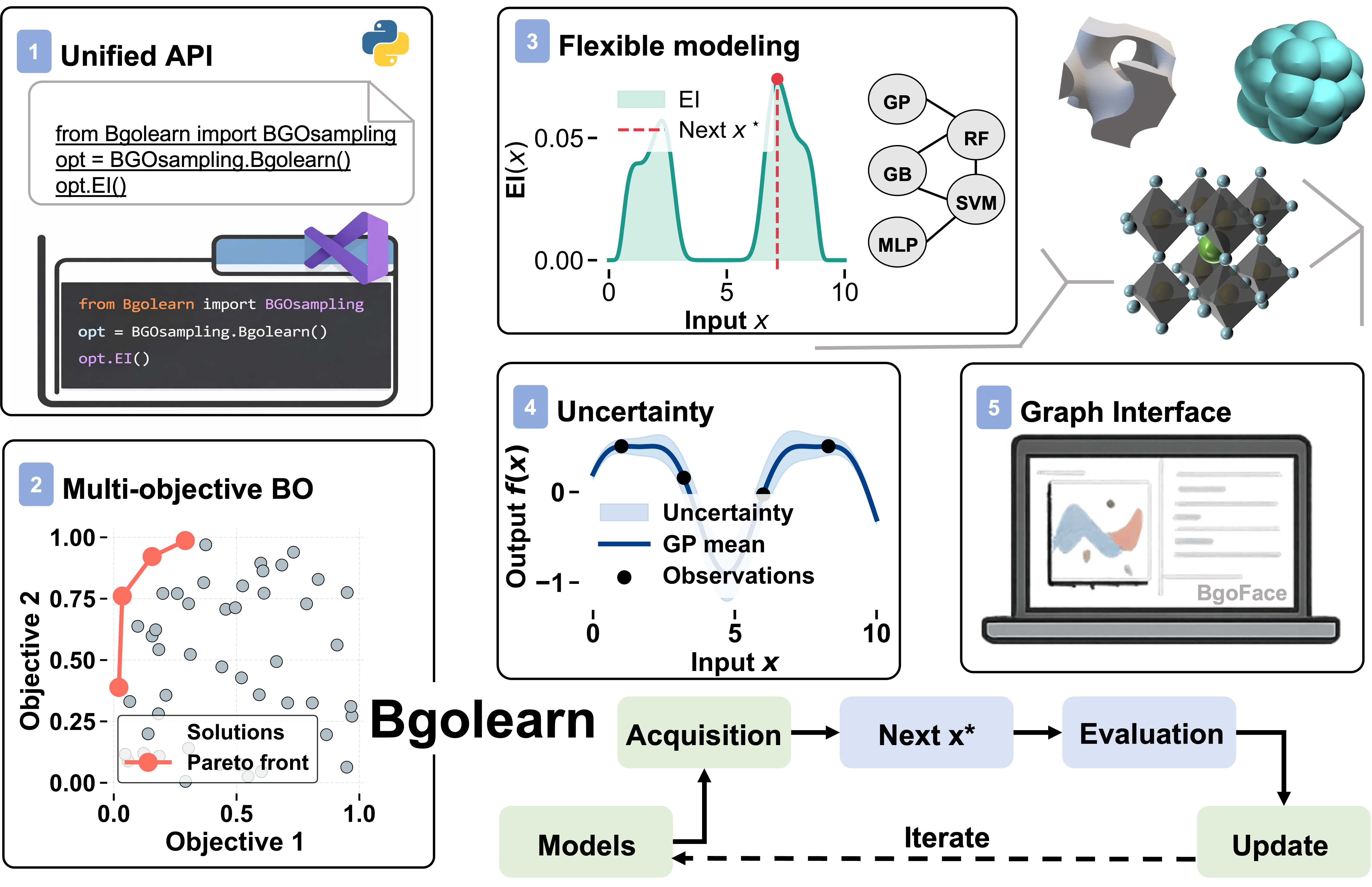
Bgolearn: a unified Bayesian optimization framework for accelerating materials discovery
Bgolearn Bayesian optimization materials discovery Python framework active learning experimental optimization
Efficient exploration of vast compositional and processing spaces is essential for accelerated materials discovery. Bayesian optimization (BO) provides a principled strategy for identifying optimal materials with minimal experiments, yet its adoption in materials science is hindered by implementation complexity and limited domain-specific tools. Here, we present Bgolearn, a comprehensive Python framework that makes BO accessible and practical for materials research through an intuitive interface, robust algorithms, and materials-oriented workflows.
Bgolearn: a unified Bayesian optimization framework for accelerating materials discovery
Bgolearn Bayesian optimization materials discovery Python framework active learning experimental optimization
Efficient exploration of vast compositional and processing spaces is essential for accelerated materials discovery. Bayesian optimization (BO) provides a principled strategy for identifying optimal materials with minimal experiments, yet its adoption in materials science is hindered by implementation complexity and limited domain-specific tools. Here, we present Bgolearn, a comprehensive Python framework that makes BO accessible and practical for materials research through an intuitive interface, robust algorithms, and materials-oriented workflows.
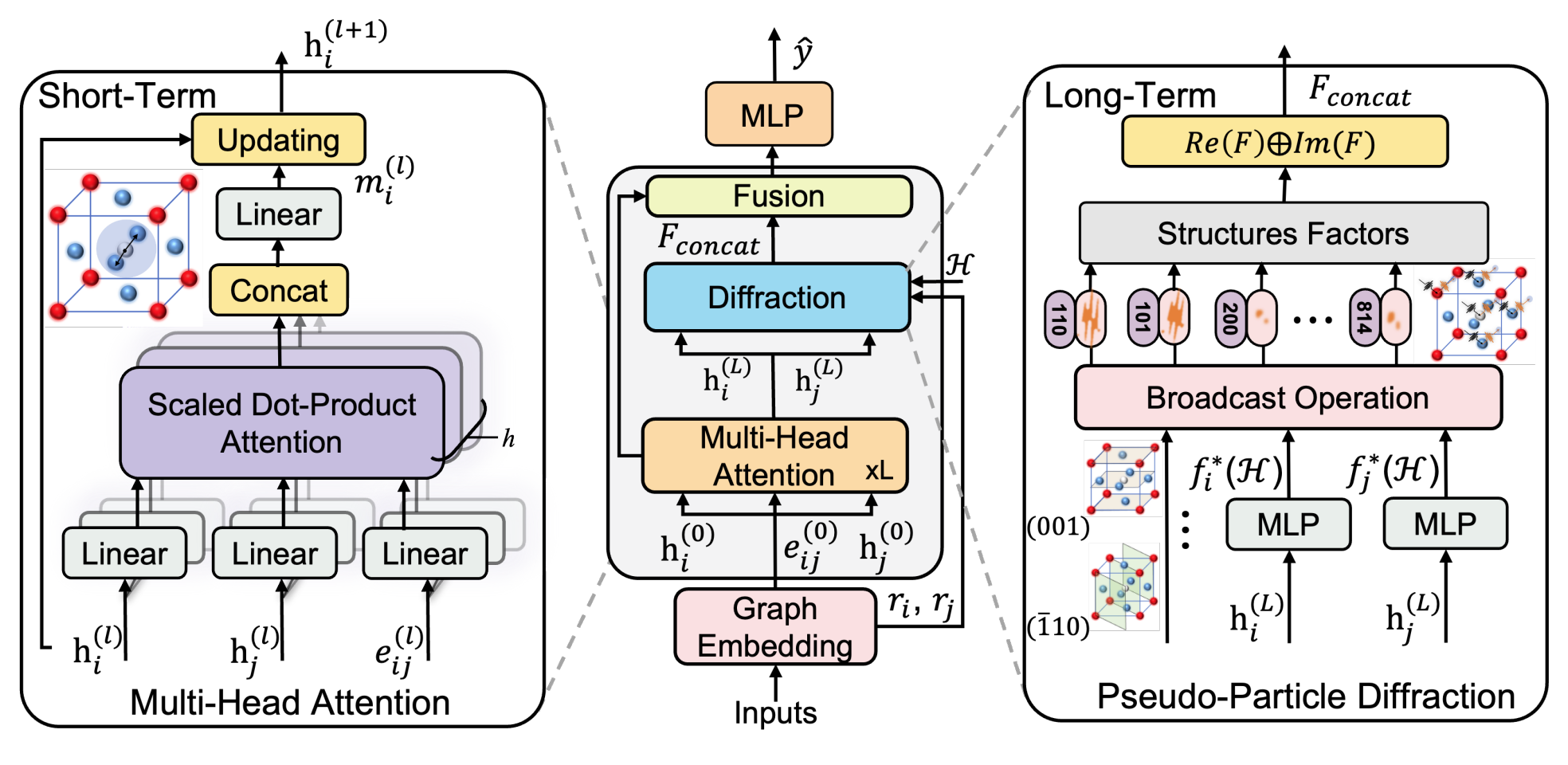
Beyond Structure: Invariant Crystal Property Prediction with Pseudo-Particle Ray Diffraction
PRDNet crystal property prediction pseudo-particle ray diffraction graph embeddings symmetry invariance ICLR
We propose PRDNet, a novel architecture that integrates graph embeddings with a learned pseudoparticle diffraction module. It generates synthetic diffraction patterns that are invariant to crystallographic symmetries. We extensively evaluate PRDNet on multiple large-scale benchmarks, including Materials Project, JARVIS-DFT, and MatBench. Our model achieves state-of-the-art performance across a wide range of crystal property prediction tasks, demonstrating its effectiveness.
Beyond Structure: Invariant Crystal Property Prediction with Pseudo-Particle Ray Diffraction
PRDNet crystal property prediction pseudo-particle ray diffraction graph embeddings symmetry invariance ICLR
We propose PRDNet, a novel architecture that integrates graph embeddings with a learned pseudoparticle diffraction module. It generates synthetic diffraction patterns that are invariant to crystallographic symmetries. We extensively evaluate PRDNet on multiple large-scale benchmarks, including Materials Project, JARVIS-DFT, and MatBench. Our model achieves state-of-the-art performance across a wide range of crystal property prediction tasks, demonstrating its effectiveness.
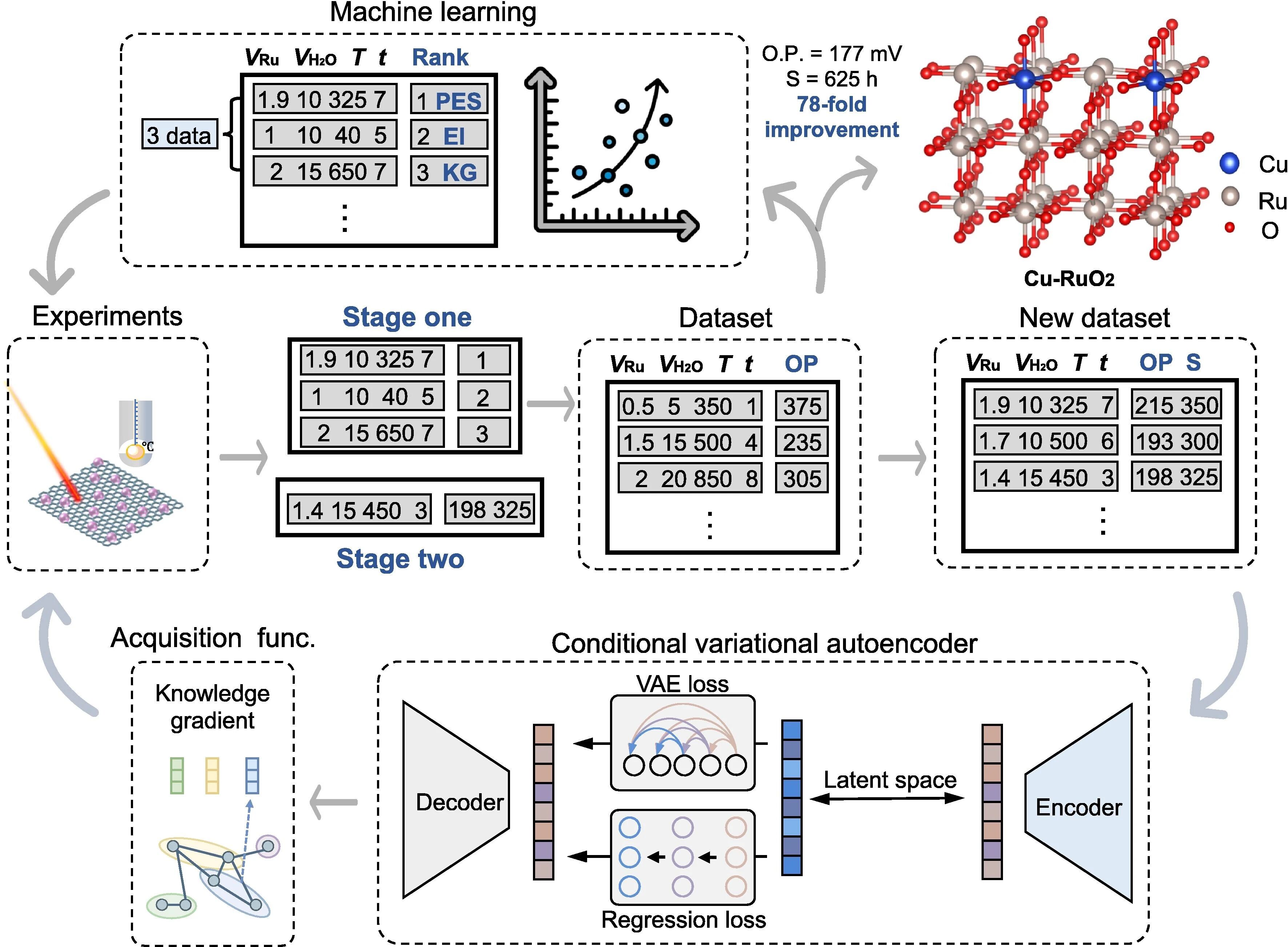
Spatial-adaptive active learning identifies ultra-durable and highly active catalysts for acidic oxygen evolution reaction
spatial-adaptive active learning acidic oxygen evolution reaction catalyst optimization Bayesian optimization Cu-RuO2 closed-loop experimentation
Here, we present a spatially adaptive active-learning framework with closed-loop experimentation for targeted catalyst optimization. Bayesian optimization and a conditional variational autoencoder first identify a low-overpotential stability subspace, followed by active learning to pinpoint the most stable candidate. This strategy leads to the discovery of a Cu–RuO₂ catalyst with outstanding durability (625 h) and a low overpotential of 177 mV at 10 mA cm⁻². Our results highlight an efficient AI-driven pathway for accelerating the design of stable acidic OER catalysts.
Spatial-adaptive active learning identifies ultra-durable and highly active catalysts for acidic oxygen evolution reaction
spatial-adaptive active learning acidic oxygen evolution reaction catalyst optimization Bayesian optimization Cu-RuO2 closed-loop experimentation
Here, we present a spatially adaptive active-learning framework with closed-loop experimentation for targeted catalyst optimization. Bayesian optimization and a conditional variational autoencoder first identify a low-overpotential stability subspace, followed by active learning to pinpoint the most stable candidate. This strategy leads to the discovery of a Cu–RuO₂ catalyst with outstanding durability (625 h) and a low overpotential of 177 mV at 10 mA cm⁻². Our results highlight an efficient AI-driven pathway for accelerating the design of stable acidic OER catalysts.
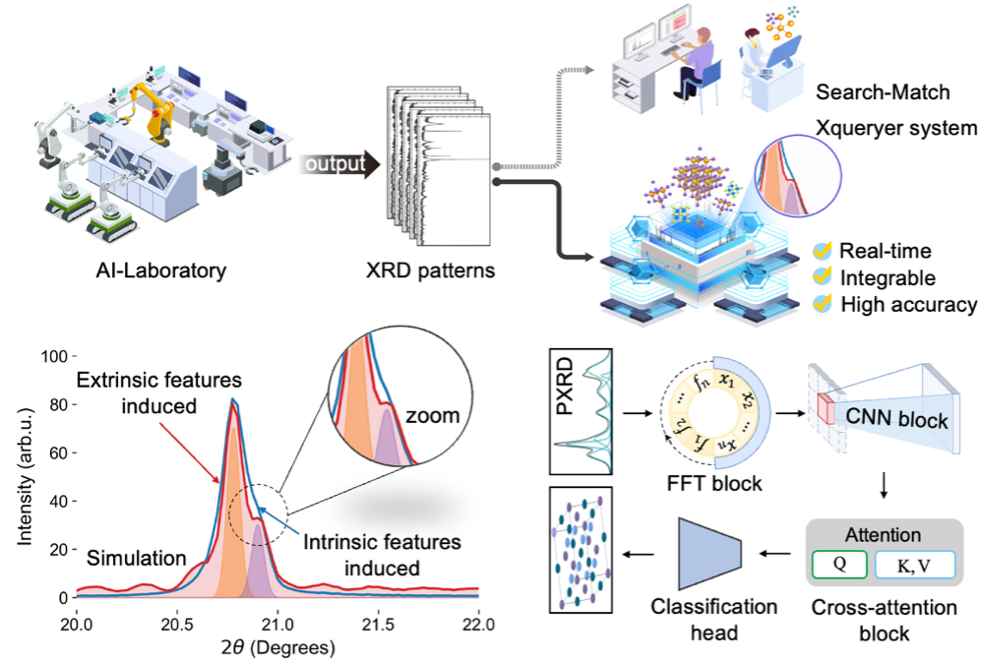
XQueryer: an intelligent crystal structure identifier for powder X-ray diffraction
XQueryer crystal structure identification powder X-ray diffraction intelligent agent real-time analysis materials characterization
We developed XQueryer, an intelligent agent for simulating, recognizing, and analyzing powder X-ray diffraction (PXRD) patterns. Trained on over two million high-fidelity simulated spectra, XQueryer achieves significantly higher accuracy—28.9% better than existing AI models and traditional methods. Integrated with a powder diffractometer, it enables real-time structural analysis of crystal samples.
XQueryer: an intelligent crystal structure identifier for powder X-ray diffraction
XQueryer crystal structure identification powder X-ray diffraction intelligent agent real-time analysis materials characterization
We developed XQueryer, an intelligent agent for simulating, recognizing, and analyzing powder X-ray diffraction (PXRD) patterns. Trained on over two million high-fidelity simulated spectra, XQueryer achieves significantly higher accuracy—28.9% better than existing AI models and traditional methods. Integrated with a powder diffractometer, it enables real-time structural analysis of crystal samples.
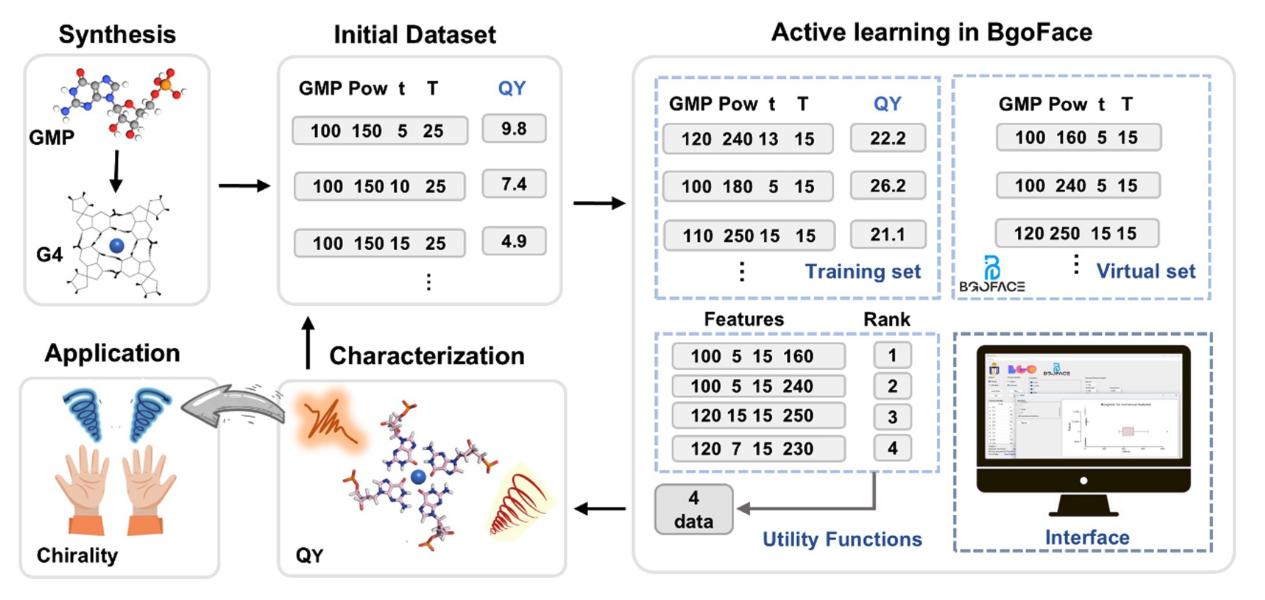
Optimize the quantum yield of G‐quartet‐based circularly polarized luminescence materials via active learning strategy‐BgoFace
BgoFace active learning circularly polarized luminescence G-quartet materials quantum yield material optimization
This work developed an integrated AL software, BgoFace, which satisfies most material property optimization re-quirements. The application of BgoFace (with default setting) successfully accel-erated the discovery of G4-based CPL materials, achievingresults within six iterations and synthesizing 24 experimentalgroups. The final QY nearly doubled the initial best QY inthe training dataset.
Optimize the quantum yield of G‐quartet‐based circularly polarized luminescence materials via active learning strategy‐BgoFace
BgoFace active learning circularly polarized luminescence G-quartet materials quantum yield material optimization
This work developed an integrated AL software, BgoFace, which satisfies most material property optimization re-quirements. The application of BgoFace (with default setting) successfully accel-erated the discovery of G4-based CPL materials, achievingresults within six iterations and synthesizing 24 experimentalgroups. The final QY nearly doubled the initial best QY inthe training dataset.
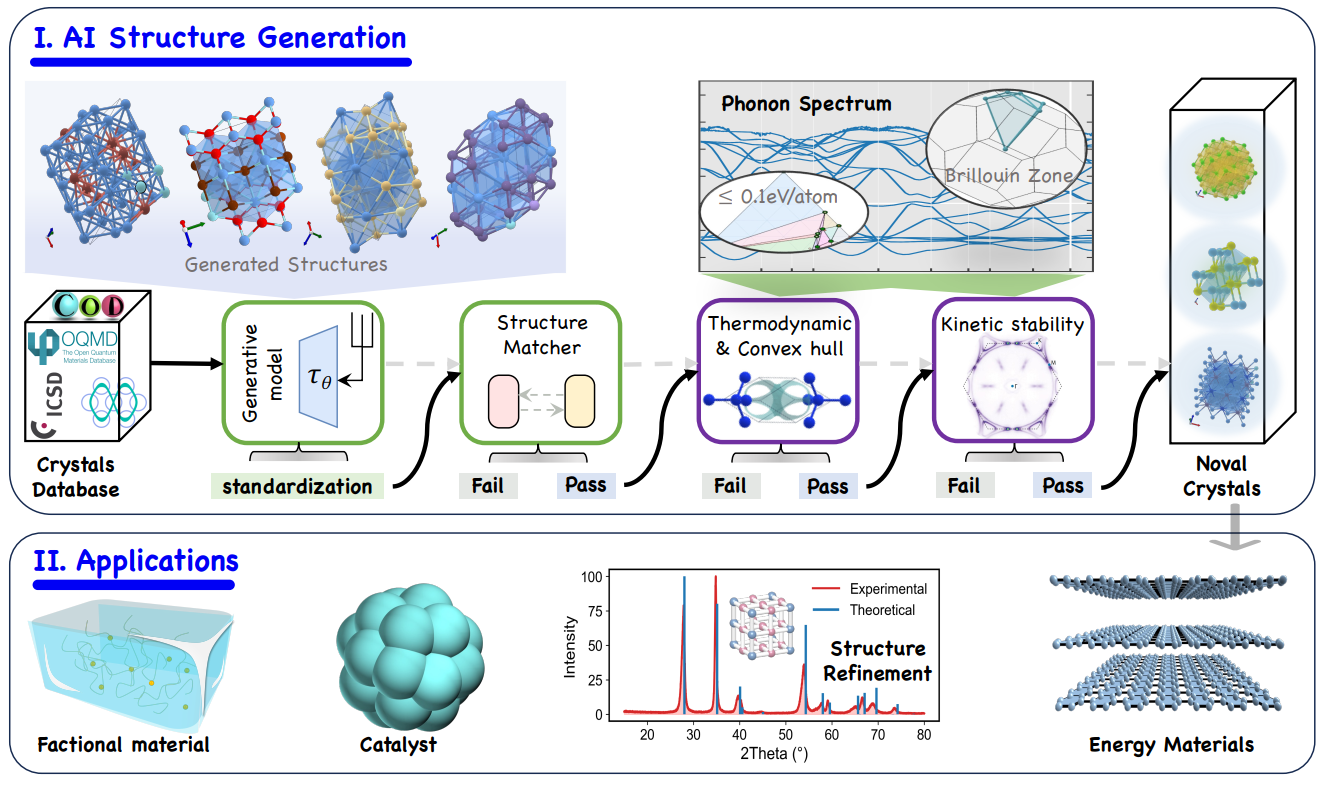
Materials Generation in the Era of Artificial Intelligence: A Comprehensive Survey
materials generation artificial intelligence survey crystal representation benchmark datasets generative models
We first organize various types of materials and illustrate multiple representations of crystalline materials. We then provide a detailed summary and taxonomy of current AI-driven materials generation approaches. Furthermore, we discuss the common evaluation metrics and summarize open-source codes and benchmark datasets. Finally, we conclude with potential future directions and challenges in this fast-growing field.
Materials Generation in the Era of Artificial Intelligence: A Comprehensive Survey
materials generation artificial intelligence survey crystal representation benchmark datasets generative models
We first organize various types of materials and illustrate multiple representations of crystalline materials. We then provide a detailed summary and taxonomy of current AI-driven materials generation approaches. Furthermore, we discuss the common evaluation metrics and summarize open-source codes and benchmark datasets. Finally, we conclude with potential future directions and challenges in this fast-growing field.
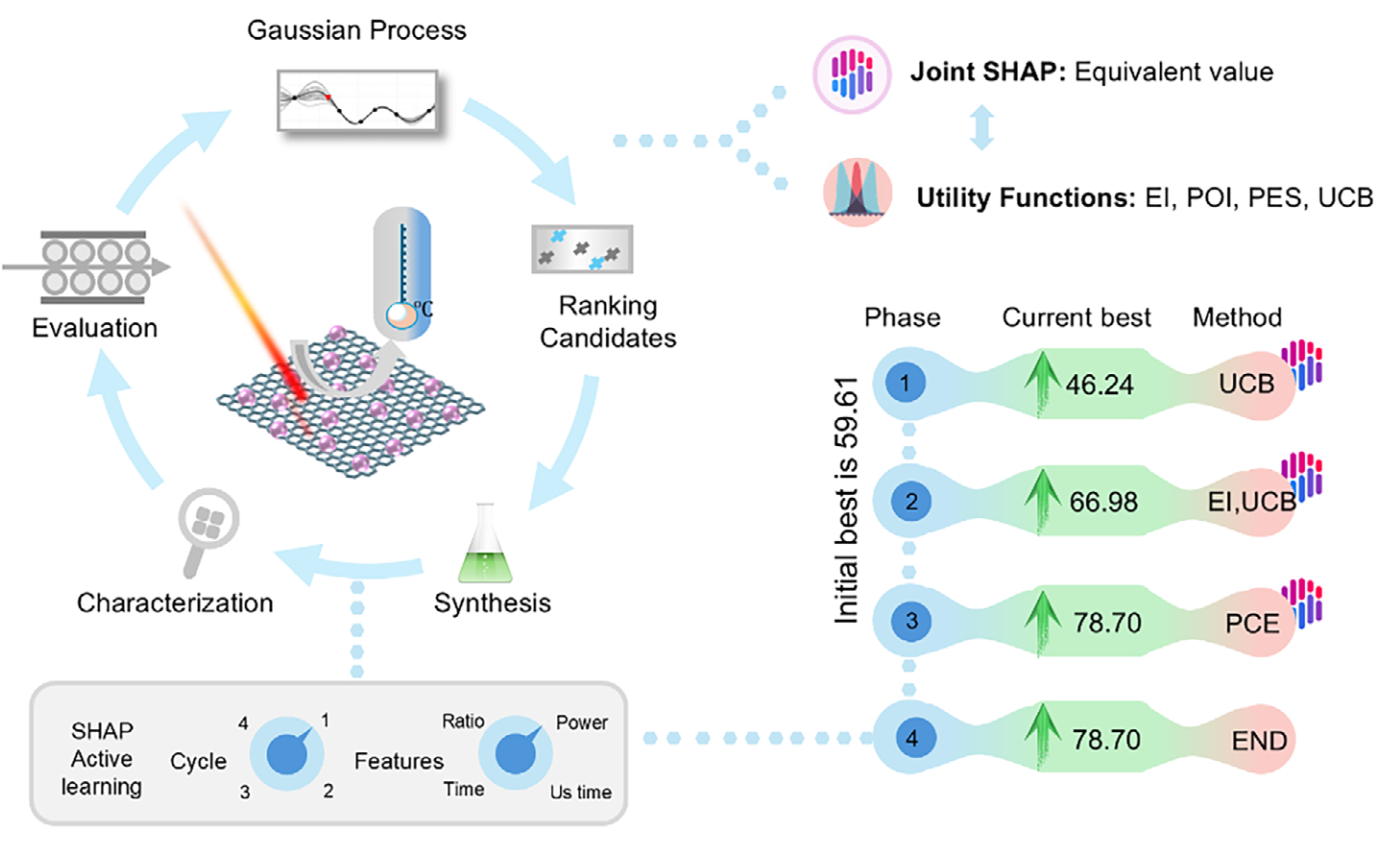
Interpretable Active Learning Identifies Iron-Doped Carbon Dots With High Photothermal Conversion Efficiency for Antitumor Synergistic Therapy
interpretable active learning carbon dots photothermal conversion iron doping antitumor therapy SHAP
We apply an interpretable AL strategy to efficiently optimize the photothermal conversion efficiency (PCE) of carbon dots (CDs) in photothermal therapy (PTT). Using this approach, we successfully synthesized irondoped CDs (Fe-CDs) with PCE exceeding 78.7% after only 16 experimental trials over four iterations.
Interpretable Active Learning Identifies Iron-Doped Carbon Dots With High Photothermal Conversion Efficiency for Antitumor Synergistic Therapy
interpretable active learning carbon dots photothermal conversion iron doping antitumor therapy SHAP
We apply an interpretable AL strategy to efficiently optimize the photothermal conversion efficiency (PCE) of carbon dots (CDs) in photothermal therapy (PTT). Using this approach, we successfully synthesized irondoped CDs (Fe-CDs) with PCE exceeding 78.7% after only 16 experimental trials over four iterations.
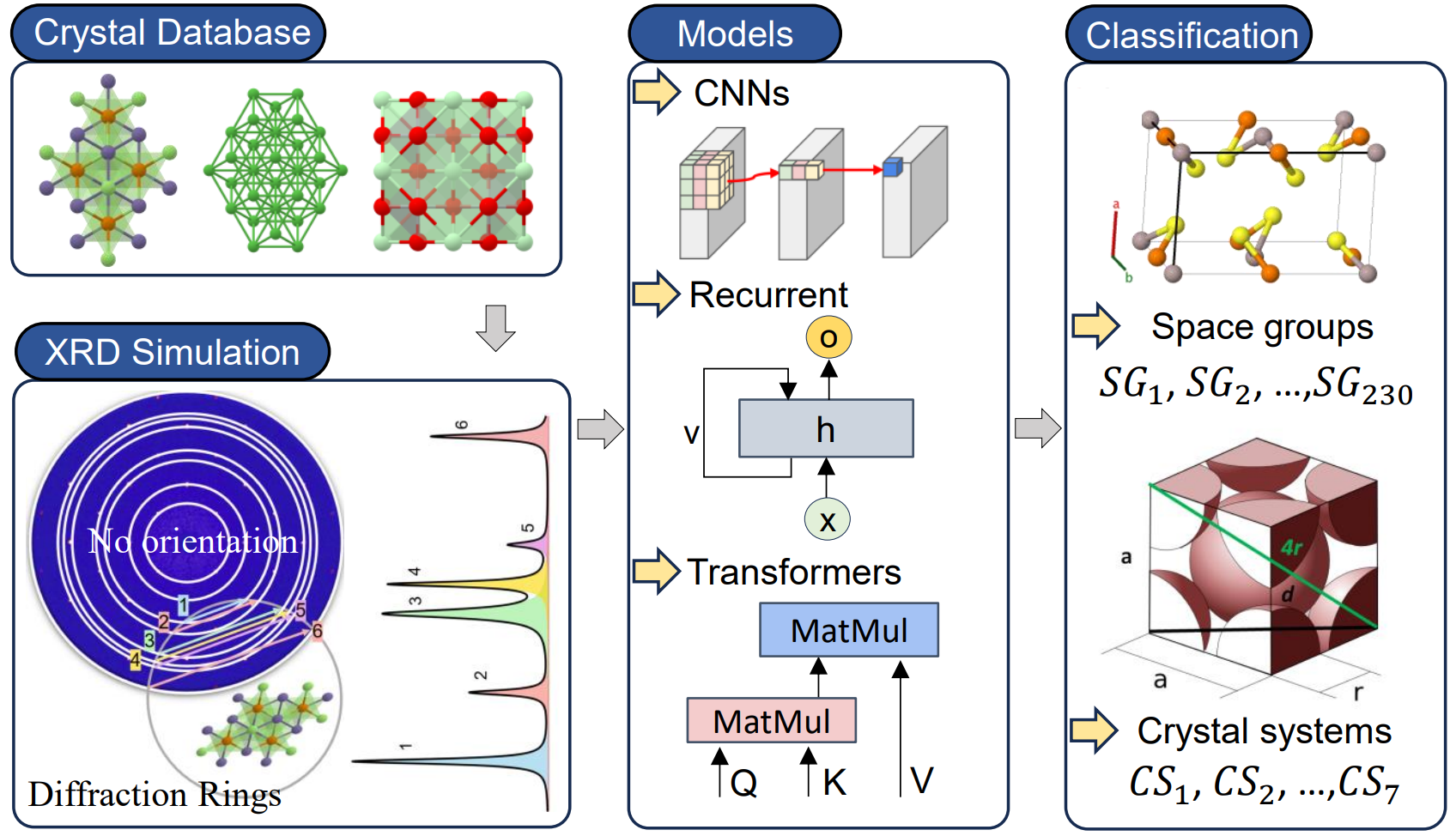
SimXRD-4M: Big Simulated X-ray Diffraction Data and Crystal Symmetry Classification Benchmark
SimXRD X-ray diffraction simulation crystal symmetry classification benchmark dataset powder XRD ICLR
We developed a novel XRD simulation method that incorporates comprehensive physical interactions, resulting in a high-fidelity database. SimXRD comprises 4,065,346 simulated powder XRD patterns, representing 119,569 unique crystal structures under 33 simulated conditions that reflect real-world variations. We benchmark 21 sequence models in both in-library and out-of-library scenarios and analyze the impact of class imbalance in longtailed crystal label distributions. Remarkably, we find that: (1) current neural networks struggle with classifying low-frequency crystals, particularly in out-oflibrary situations; (2) models trained on SimXRD can generalize to real experimental data.
SimXRD-4M: Big Simulated X-ray Diffraction Data and Crystal Symmetry Classification Benchmark
SimXRD X-ray diffraction simulation crystal symmetry classification benchmark dataset powder XRD ICLR
We developed a novel XRD simulation method that incorporates comprehensive physical interactions, resulting in a high-fidelity database. SimXRD comprises 4,065,346 simulated powder XRD patterns, representing 119,569 unique crystal structures under 33 simulated conditions that reflect real-world variations. We benchmark 21 sequence models in both in-library and out-of-library scenarios and analyze the impact of class imbalance in longtailed crystal label distributions. Remarkably, we find that: (1) current neural networks struggle with classifying low-frequency crystals, particularly in out-oflibrary situations; (2) models trained on SimXRD can generalize to real experimental data.
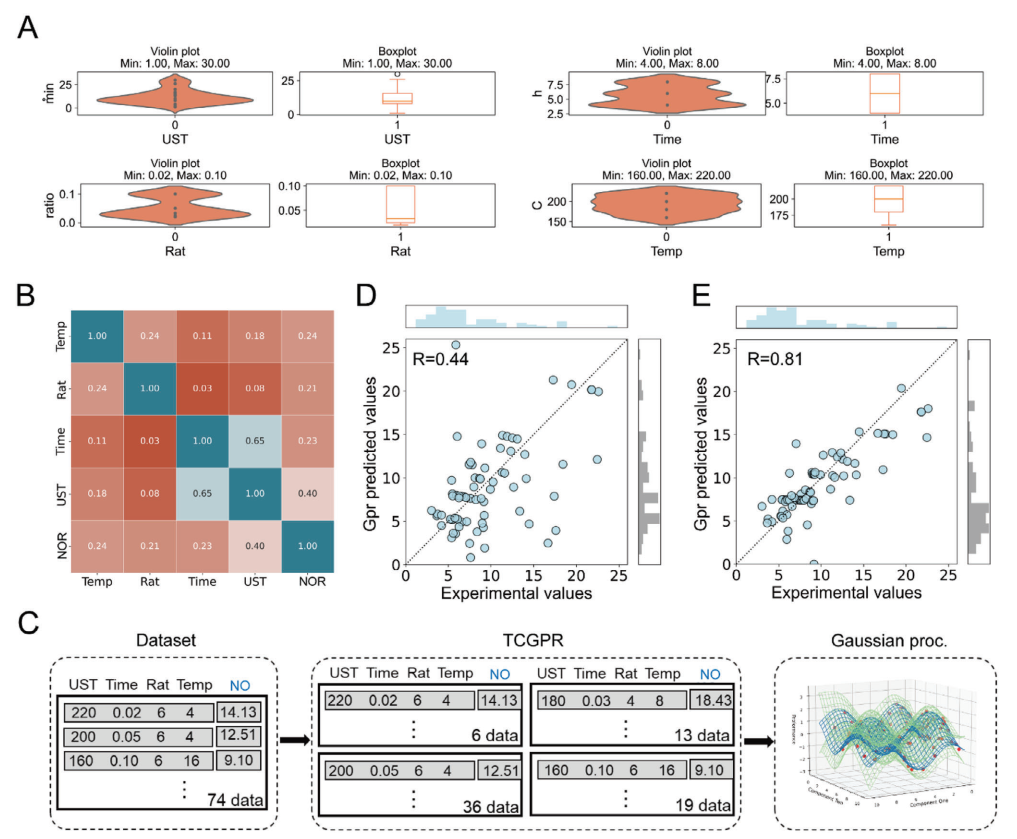
Machine Learning-Engineered Nanozyme System for Synergistic Anti-Tumor Ferroptosis/Apoptosis Therapy
nanozyme ferroptosis apoptosis therapy anti-tumor therapy TCGPR machine learning
A novel ML model, termed the sequential backward Tree-Classifier for Gaussian Process Regression (TCGPR), is proposed to improve data pattern recognition following the divide-and-conquer principle.
Machine Learning-Engineered Nanozyme System for Synergistic Anti-Tumor Ferroptosis/Apoptosis Therapy
nanozyme ferroptosis apoptosis therapy anti-tumor therapy TCGPR machine learning
A novel ML model, termed the sequential backward Tree-Classifier for Gaussian Process Regression (TCGPR), is proposed to improve data pattern recognition following the divide-and-conquer principle.
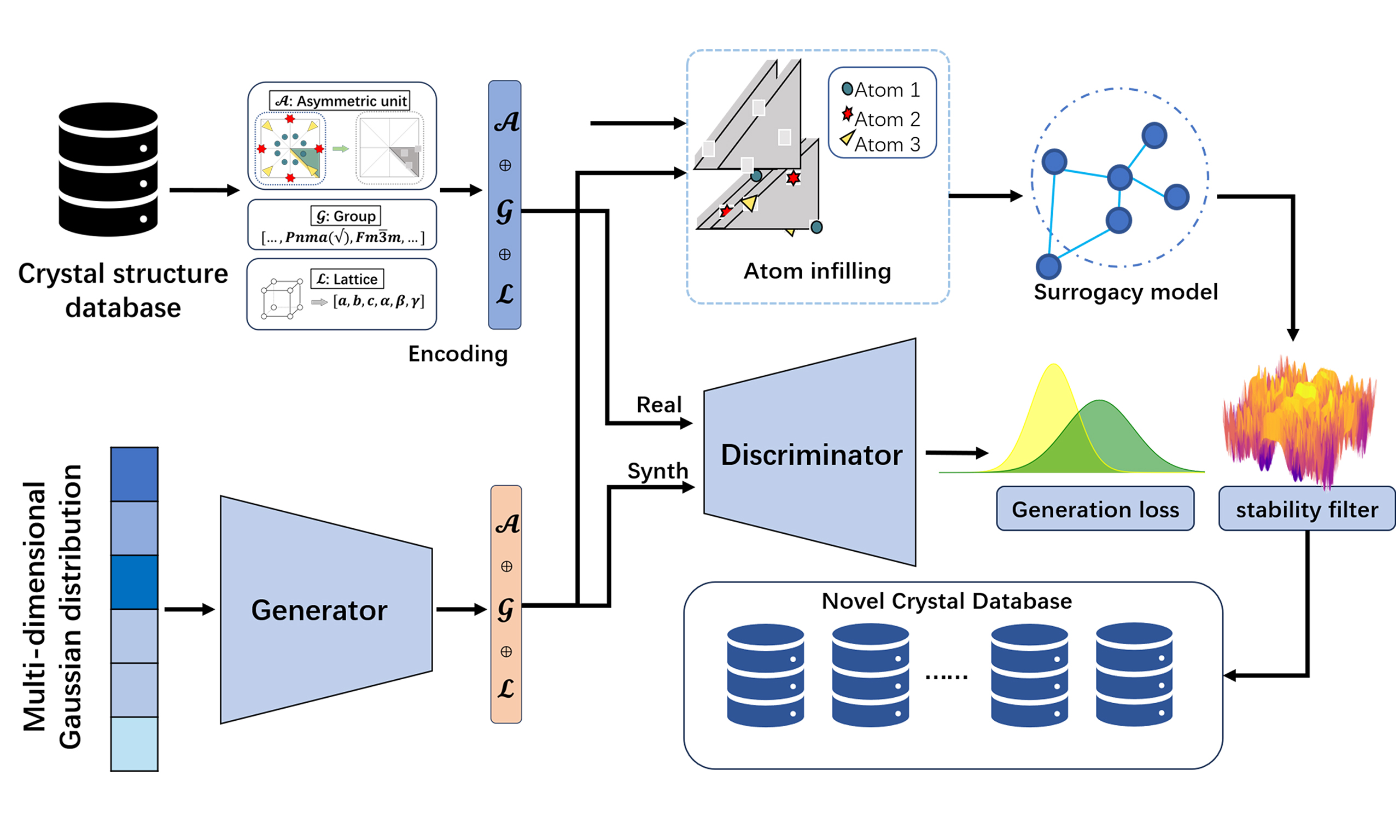
CGWGAN: crystal generative framework based on Wyckoff generative adversarial network
CGWGAN crystal generation Wyckoff positions generative adversarial network novel crystals materials generation
In this work, we present a crystal generative framework based on Wyckoff generative adversarial network (CGWGAN) to efficiently discover novel crystals.
CGWGAN: crystal generative framework based on Wyckoff generative adversarial network
CGWGAN crystal generation Wyckoff positions generative adversarial network novel crystals materials generation
In this work, we present a crystal generative framework based on Wyckoff generative adversarial network (CGWGAN) to efficiently discover novel crystals.
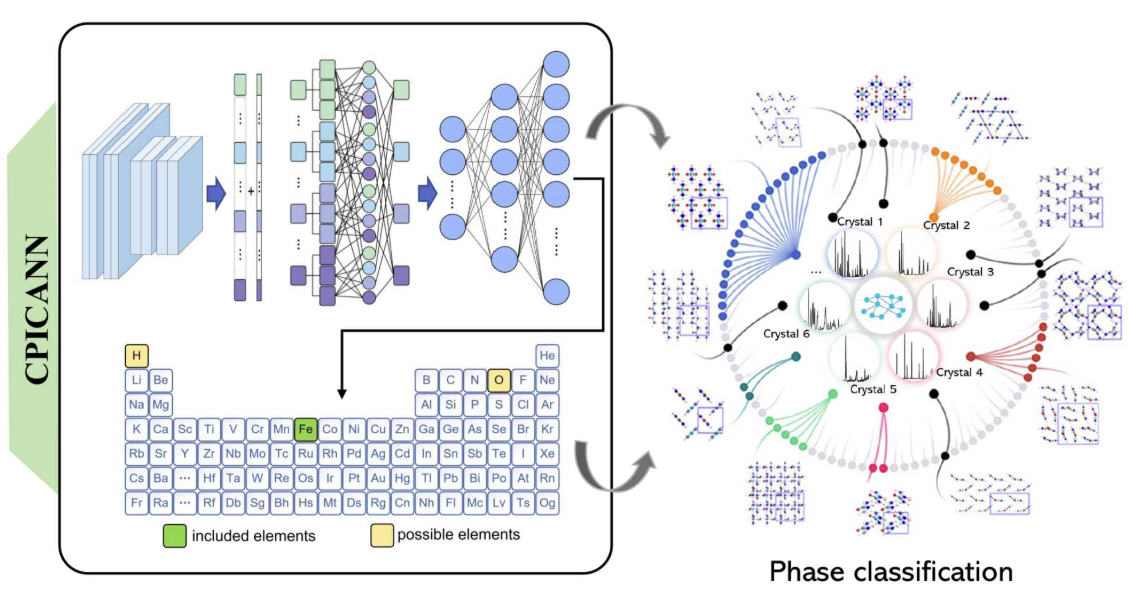
Crystallographic Phase Identifier of a Convolutional Self-Attention Neural Network (CPICANN) on Powder Diffraction Patterns
CPICANN powder diffraction phase identification convolutional neural network self-attention crystallography
In this work, we developed a machine learning phase identifier that achieved excellent performance for structure identification from powder diffraction patterns.
Crystallographic Phase Identifier of a Convolutional Self-Attention Neural Network (CPICANN) on Powder Diffraction Patterns
CPICANN powder diffraction phase identification convolutional neural network self-attention crystallography
In this work, we developed a machine learning phase identifier that achieved excellent performance for structure identification from powder diffraction patterns.
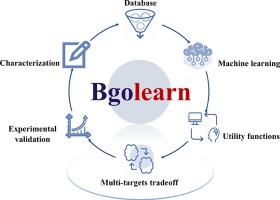
Active Learning Accelerates the Discovery of High Strength and High Ductility Lead-Free Solder Alloys
active learning lead-free solder alloys high strength high ductility Bgolearn materials informatics
To facilitate materials informatics development, all active learning algorithms were made open-source in our designed framework, Bgolearn
Active Learning Accelerates the Discovery of High Strength and High Ductility Lead-Free Solder Alloys
active learning lead-free solder alloys high strength high ductility Bgolearn materials informatics
To facilitate materials informatics development, all active learning algorithms were made open-source in our designed framework, Bgolearn
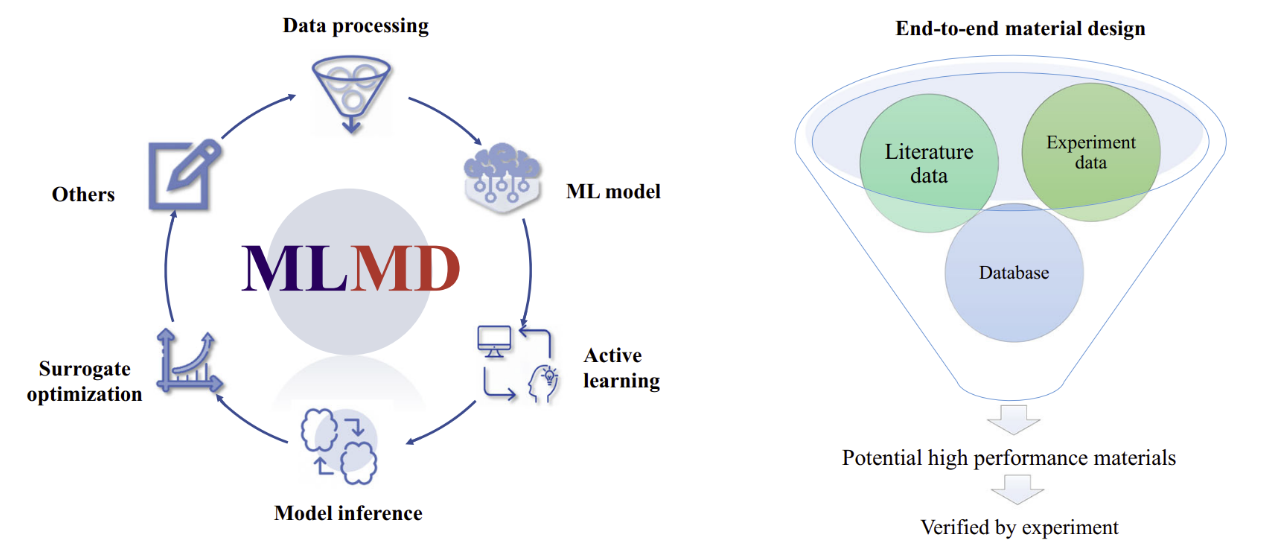
MLMD: a programming-free AI platform to predict and design materials
MLMD AI platform materials design active learning surrogate optimization materials discovery
We developed MLMD, an AI platform for materials design. It is capable of effectively discovering novel materials with high-potential advanced properties end-to-end, utilizing model inference, surrogate optimization, and even working in situations of data scarcity based on active learning.
MLMD: a programming-free AI platform to predict and design materials
MLMD AI platform materials design active learning surrogate optimization materials discovery
We developed MLMD, an AI platform for materials design. It is capable of effectively discovering novel materials with high-potential advanced properties end-to-end, utilizing model inference, surrogate optimization, and even working in situations of data scarcity based on active learning.
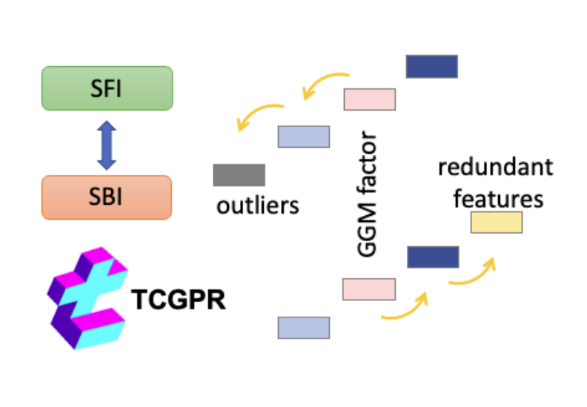
Divide and conquer: Machine learning accelerated design of lead-free solder alloys with high strength and high ductility
lead-free solder alloys alloy design high strength high ductility machine learning TCGPR
In general, small in size and big in noise, while the design space is huge, by a newly developed data preprocessing algorithm, named the Tree-Classifier for Gaussian Process Regression (TCGPR)….
Divide and conquer: Machine learning accelerated design of lead-free solder alloys with high strength and high ductility
lead-free solder alloys alloy design high strength high ductility machine learning TCGPR
In general, small in size and big in noise, while the design space is huge, by a newly developed data preprocessing algorithm, named the Tree-Classifier for Gaussian Process Regression (TCGPR)….
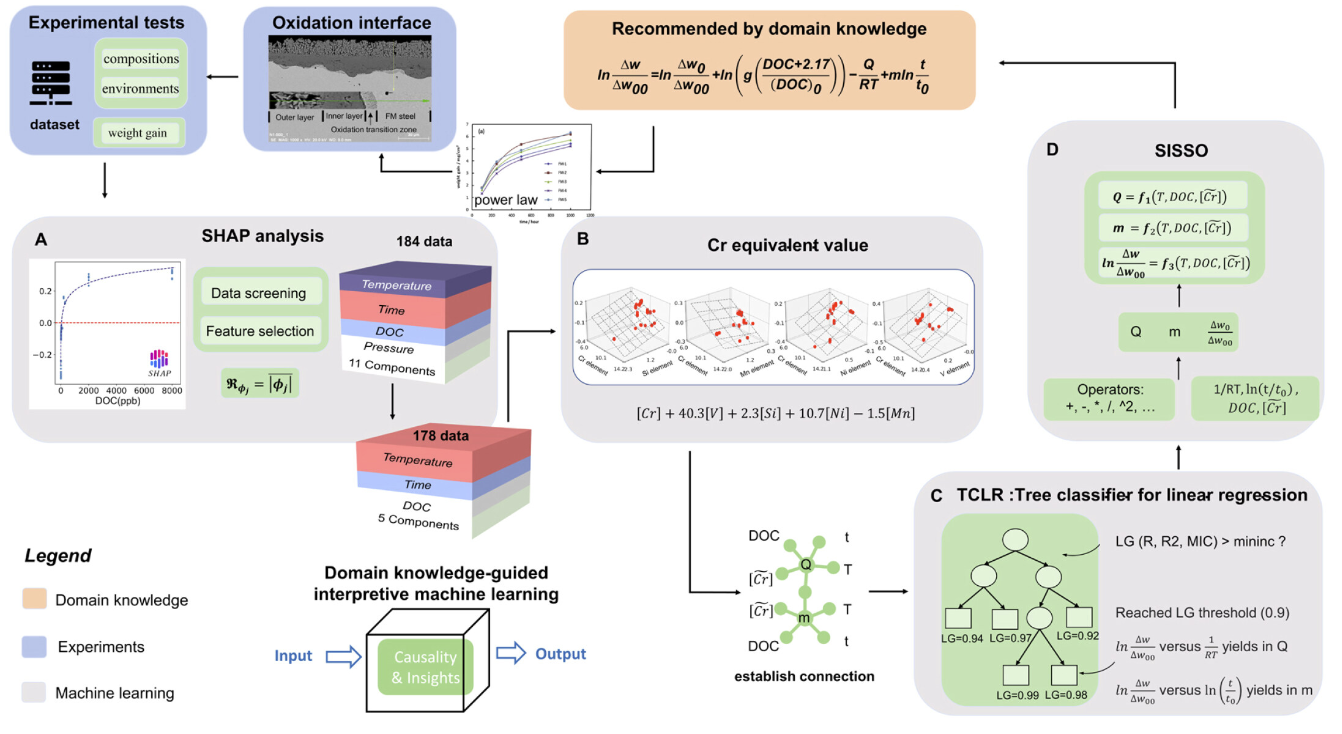
Domain knowledge-guided interpretive machine learning: formula discovery for the oxidation behavior of ferritic-martensitic steels in supercritical water
interpretable machine learning formula discovery ferritic-martensitic steels oxidation behavior supercritical water TCLR
In this study, we propose a domain knowledge-guided interpretive machine learning strategy and demonstrate it by studying the oxidation behavior of ferritic-martensitic steels in supercritical water…
Domain knowledge-guided interpretive machine learning: formula discovery for the oxidation behavior of ferritic-martensitic steels in supercritical water
interpretable machine learning formula discovery ferritic-martensitic steels oxidation behavior supercritical water TCLR
In this study, we propose a domain knowledge-guided interpretive machine learning strategy and demonstrate it by studying the oxidation behavior of ferritic-martensitic steels in supercritical water…
No matching publications.