The Hong Kong University of Science and Technology (Guangzhou)
I am a PhD student at HKUST (Guangzhou), working with Prof. ZHANG Tong-Yi. My research focuses on artificial intelligence for materials science, with particular emphasis on algorithm development for crystallography and spectroscopy. During my PhD, I also served as a visiting student at City University of Hong Kong, working with Prof. REN Yang, and an intern at Shanghai AI Lab (AI4S Department).
Before joining HKUST (Guangzhou), I earned an MPhil in Mechanics at Shanghai University, working with Prof. ZHANG Tong-Yi. During this period, I also interned at Zhejiang Laboratory, where I worked on transfer learning for materials science. I received my BEng in Chemical Machinery from Beijing University of Chemical Technology, where my work focused on finite element and chemistry.
In recent years, I developed a series of machine-learning algorithms for large scale XRD pattern simulation (SimXRD), crystal structure determination (XQueryer), XRD pattern refinment (WPEM), and crystal property prediction (PRDNet). My first-author papers have appeared in materials science journals (e.g., National Science Review and Science Bulletin) and AI conferences such as ICLR.
One of my long-term projects, Bgolearn, received support from the Shanghai Artificial Intelligence Open Source Award Project Support Plan, where I serve as the principal developer. The project was awarded RMB 500,000 to support the development of the open-source Bgolearn platform. Outside of research, I enjoy jogging and watching movies.

I serve as a reviewer for ICLR, NeurIPS, ICML, AAAI, KDD, and Engineering Applications of Artificial Intelligence (EAAI) .
Warning
Problem: The current name of your GitHub Pages repository ("Solution: Please consider renaming the repository to "
http://".
However, if the current repository name is intended, you can ignore this message by removing "{% include widgets/debug_repo_name.html %}" in index.html.
Action required
Problem: The current root path of this site is "baseurl ("_config.yml.
Solution: Please set the
baseurl in _config.yml to "Education
-
 The Hong Kong University of Science and Technology (Guangzhou)AMAT Thrust
Ph.D. StudentSep. 2023 - present (2026 expected) -
 City University of Hong KongDepartment of Physics
Visiting Research StudentJun. 2025 - Dec. 2025 -
 Shanghai UniversityMPhil in MechanicsSep. 2020 - Jun. 2023
 -
 Beijing University of Chemical TechnologyB.S. in Chemical MachinerySep. 2016 - Jun. 2020
Experience
-
 Shanghai AI LabResearch InternJan. 2026 - Jul. 2026
 -
 Zhejiang LabResearch InternMar. 2023 - Sep. 2023
Honors & Awards
-
Outstanding Young Academic Presentation Award (CMC)2024
-
Outstanding Graduate of Shanghai University2023
-
China National Scholarship2022
News
Selected Publications (view all )
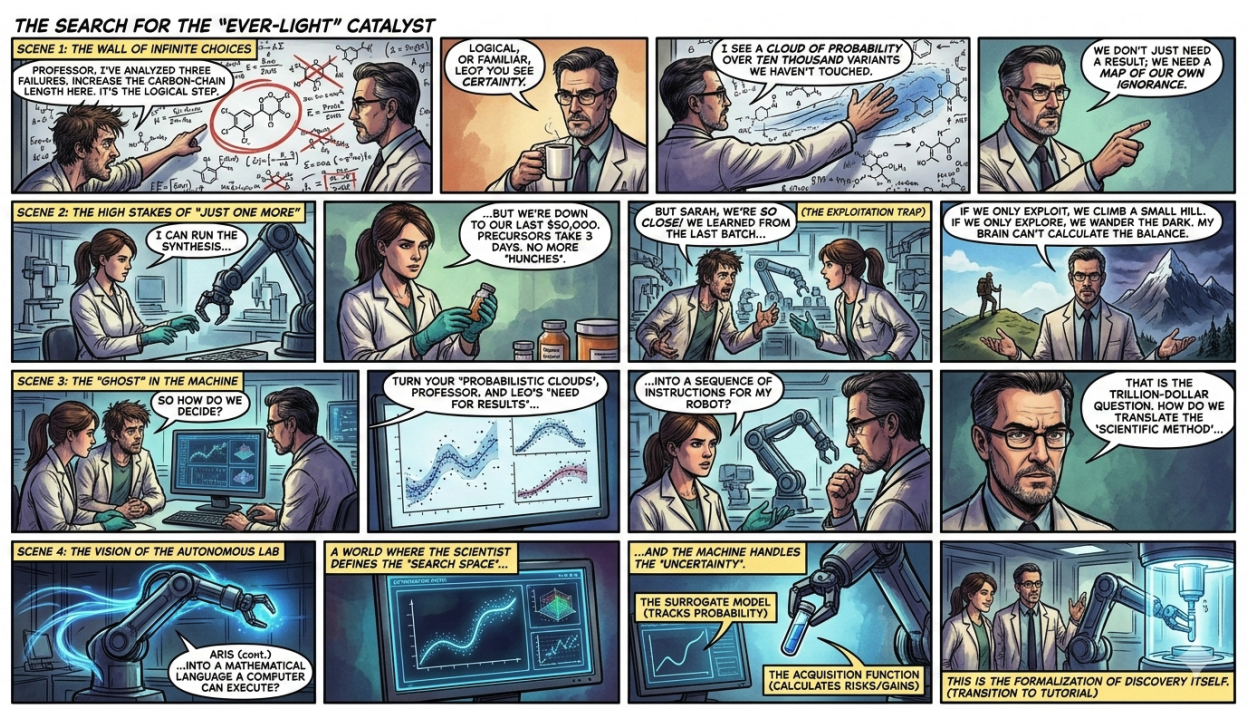
Efficient and Principled Scientific Discovery through Bayesian Optimization: A Tutorial
Zhongwei Yu*, Rasul Tutunov*, Alexandre Max Maraval*, Zikai Xie*, Zhenzhi Tan*, Jiankang Wang*, Cao Bin*, Zijing Li, Liangliang Xu, Qi Yang#, Jun Jiang#, Sanzhong Luo#, Zhenxiao Guo#, Zhang Tongyi#, Haitham Bou-Ammar#, Jun Wang# (* equal contribution, # corresponding author)
arXiv 2026
Traditional materials discovery relies on iterative hypothesis–experiment cycles, but it scales poorly with increasing complexity: problems with 5–15 design variables and costly, time-intensive experiments often allow exploration of less than 0.1% of the design space. This tutorial introduces Bayesian Optimization (BO) as a principled framework to accelerate discovery by using surrogate models, such as Gaussian processes, and acquisition functions to efficiently balance exploration and exploitation. We present the core components, practical workflows, and real-world applications of BO in areas like catalysis and molecular discovery, along with key extensions for realistic settings. Overall, this tutorial bridges theory and practice, enabling more efficient, informed, and scalable scientific discovery.
Efficient and Principled Scientific Discovery through Bayesian Optimization: A Tutorial
Zhongwei Yu*, Rasul Tutunov*, Alexandre Max Maraval*, Zikai Xie*, Zhenzhi Tan*, Jiankang Wang*, Cao Bin*, Zijing Li, Liangliang Xu, Qi Yang#, Jun Jiang#, Sanzhong Luo#, Zhenxiao Guo#, Zhang Tongyi#, Haitham Bou-Ammar#, Jun Wang# (* equal contribution, # corresponding author)
arXiv 2026
Traditional materials discovery relies on iterative hypothesis–experiment cycles, but it scales poorly with increasing complexity: problems with 5–15 design variables and costly, time-intensive experiments often allow exploration of less than 0.1% of the design space. This tutorial introduces Bayesian Optimization (BO) as a principled framework to accelerate discovery by using surrogate models, such as Gaussian processes, and acquisition functions to efficiently balance exploration and exploitation. We present the core components, practical workflows, and real-world applications of BO in areas like catalysis and molecular discovery, along with key extensions for realistic settings. Overall, this tutorial bridges theory and practice, enabling more efficient, informed, and scalable scientific discovery.
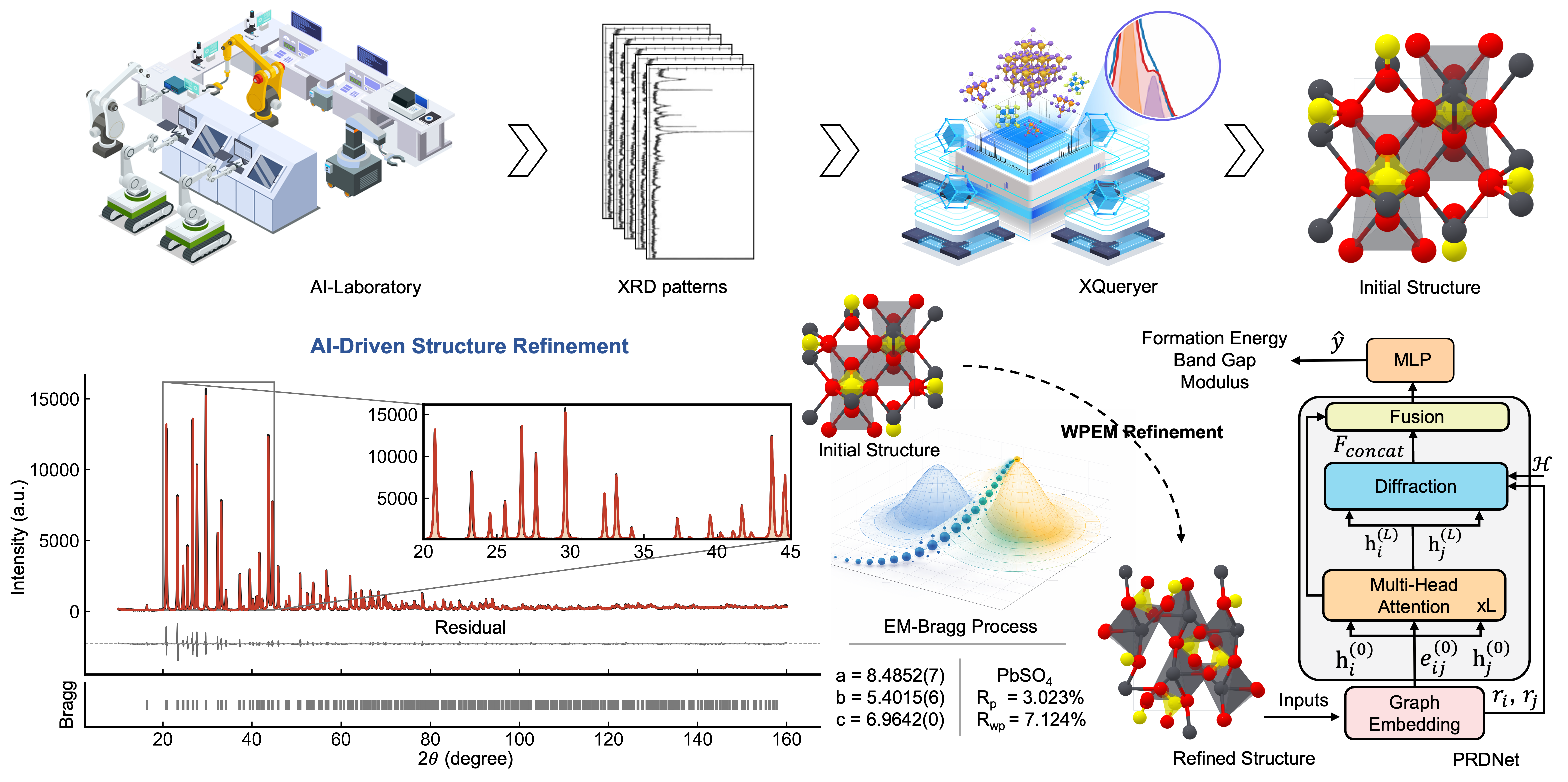
AI-Driven Structure Refinement of X-ray Diffraction
Cao Bin, Zhang Qian, Feng Zhenjie, Zhang Taolue, Huang Jiaqiang, Weng Lu-Tao, Zhang Tongyi# (# corresponding author)
arXiv 2026
AI can quickly propose candidate phases from X-ray diffraction (XRD), but refinement often fails due to unstable intensities under peak overlap and weak diffraction constraints. We introduce WPEM, a physics-constrained whole-pattern decomposition workflow that embeds Bragg's law in a batch expectation–maximization framework. WPEM models the full profile as a probabilistic mixture, iteratively inferring component intensities while keeping peak centers Bragg-consistent, producing a stable, physically valid representation. On \ce{PbSO4} and \ce{Tb2BaCoO5}, WPEM outperforms FullProf and TOPAS. It generalizes to multiphase Ti–15Nb films, \ce{NaCl}–\ce{Li2CO3} mixtures, semicrystalline polymers, operando cathodes, disordered Ru–Mn oxides (CCDC 2530452), and ancient Egyptian make-up, bridging AI-generated hypotheses and diffraction-ready structure refinement.
AI-Driven Structure Refinement of X-ray Diffraction
Cao Bin, Zhang Qian, Feng Zhenjie, Zhang Taolue, Huang Jiaqiang, Weng Lu-Tao, Zhang Tongyi# (# corresponding author)
arXiv 2026
AI can quickly propose candidate phases from X-ray diffraction (XRD), but refinement often fails due to unstable intensities under peak overlap and weak diffraction constraints. We introduce WPEM, a physics-constrained whole-pattern decomposition workflow that embeds Bragg's law in a batch expectation–maximization framework. WPEM models the full profile as a probabilistic mixture, iteratively inferring component intensities while keeping peak centers Bragg-consistent, producing a stable, physically valid representation. On \ce{PbSO4} and \ce{Tb2BaCoO5}, WPEM outperforms FullProf and TOPAS. It generalizes to multiphase Ti–15Nb films, \ce{NaCl}–\ce{Li2CO3} mixtures, semicrystalline polymers, operando cathodes, disordered Ru–Mn oxides (CCDC 2530452), and ancient Egyptian make-up, bridging AI-generated hypotheses and diffraction-ready structure refinement.
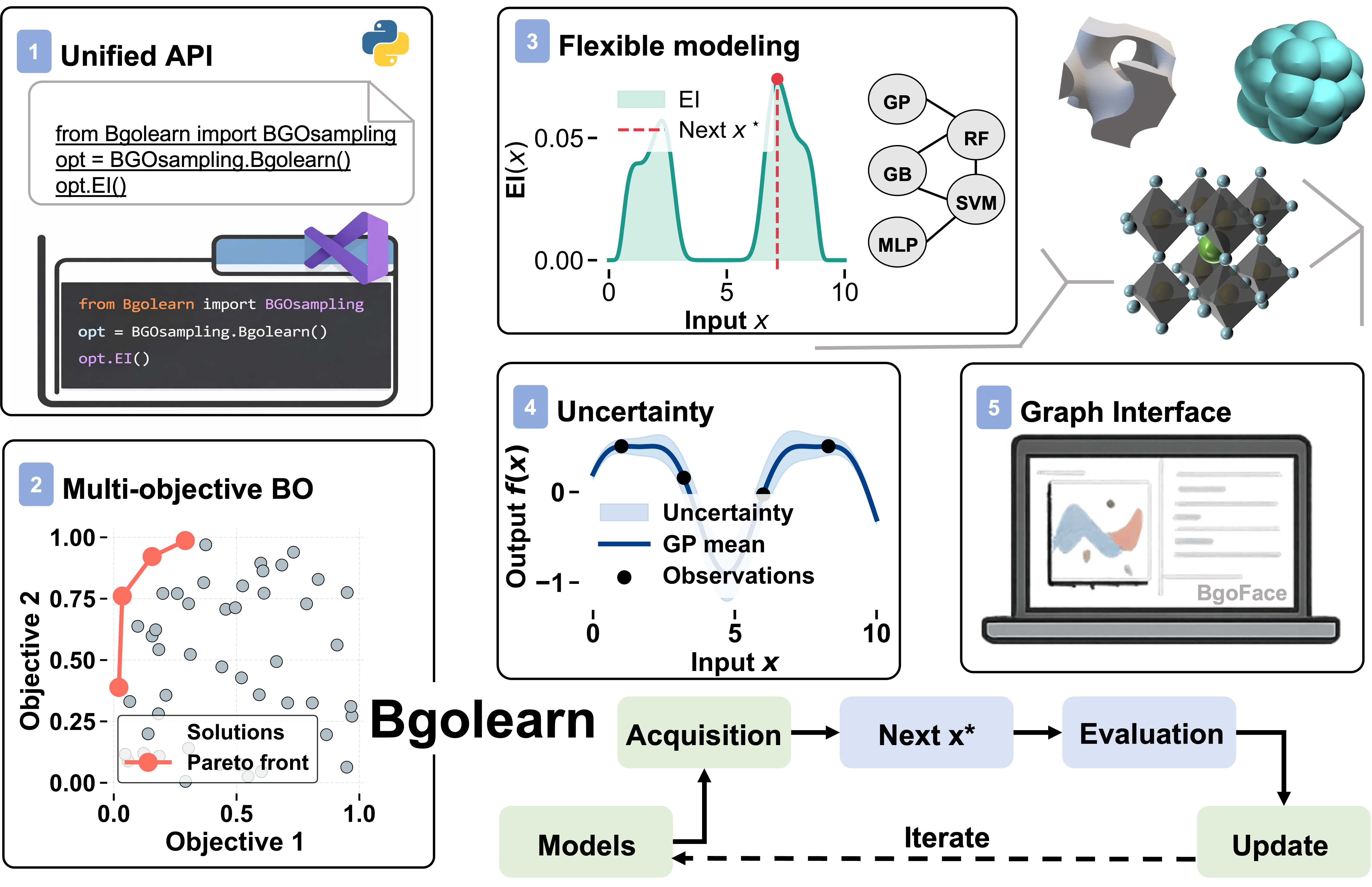
Bgolearn: a Unified Bayesian Optimization Framework for Accelerating Materials Discovery
Cao Bin, Xiong Jie#, Ma Jiaxuan, Tian Yuan, Hu Yirui, He Mengwei, Zhang Longhan, Wang Jiayu, Hui Jian#, Liu Li, Xue Dezhen, Turab Lookman#, Zhang Tongyi# (# corresponding author)
arXiv 2026
Efficient exploration of vast compositional and processing spaces is essential for accelerated materials discovery. Bayesian optimization (BO) provides a principled strategy for identifying optimal materials with minimal experiments, yet its adoption in materials science is hindered by implementation complexity and limited domain-specific tools. Here, we present Bgolearn, a comprehensive Python framework that makes BO accessible and practical for materials research through an intuitive interface, robust algorithms, and materials-oriented workflows.
Bgolearn: a Unified Bayesian Optimization Framework for Accelerating Materials Discovery
Cao Bin, Xiong Jie#, Ma Jiaxuan, Tian Yuan, Hu Yirui, He Mengwei, Zhang Longhan, Wang Jiayu, Hui Jian#, Liu Li, Xue Dezhen, Turab Lookman#, Zhang Tongyi# (# corresponding author)
arXiv 2026
Efficient exploration of vast compositional and processing spaces is essential for accelerated materials discovery. Bayesian optimization (BO) provides a principled strategy for identifying optimal materials with minimal experiments, yet its adoption in materials science is hindered by implementation complexity and limited domain-specific tools. Here, we present Bgolearn, a comprehensive Python framework that makes BO accessible and practical for materials research through an intuitive interface, robust algorithms, and materials-oriented workflows.
Beyond Structure: Invariant Crystal Property Prediction with Pseudo-Particle Ray Diffraction
Cao Bin, Liu Yang#, Zhang Longhan, Wu Yifan, Luo Yuyu, Cheng Hong, Ren Yang#, Zhang Tongyi# (# corresponding author)
International Conference on Learning Representations (ICLR) 2026 Top tier AI conference
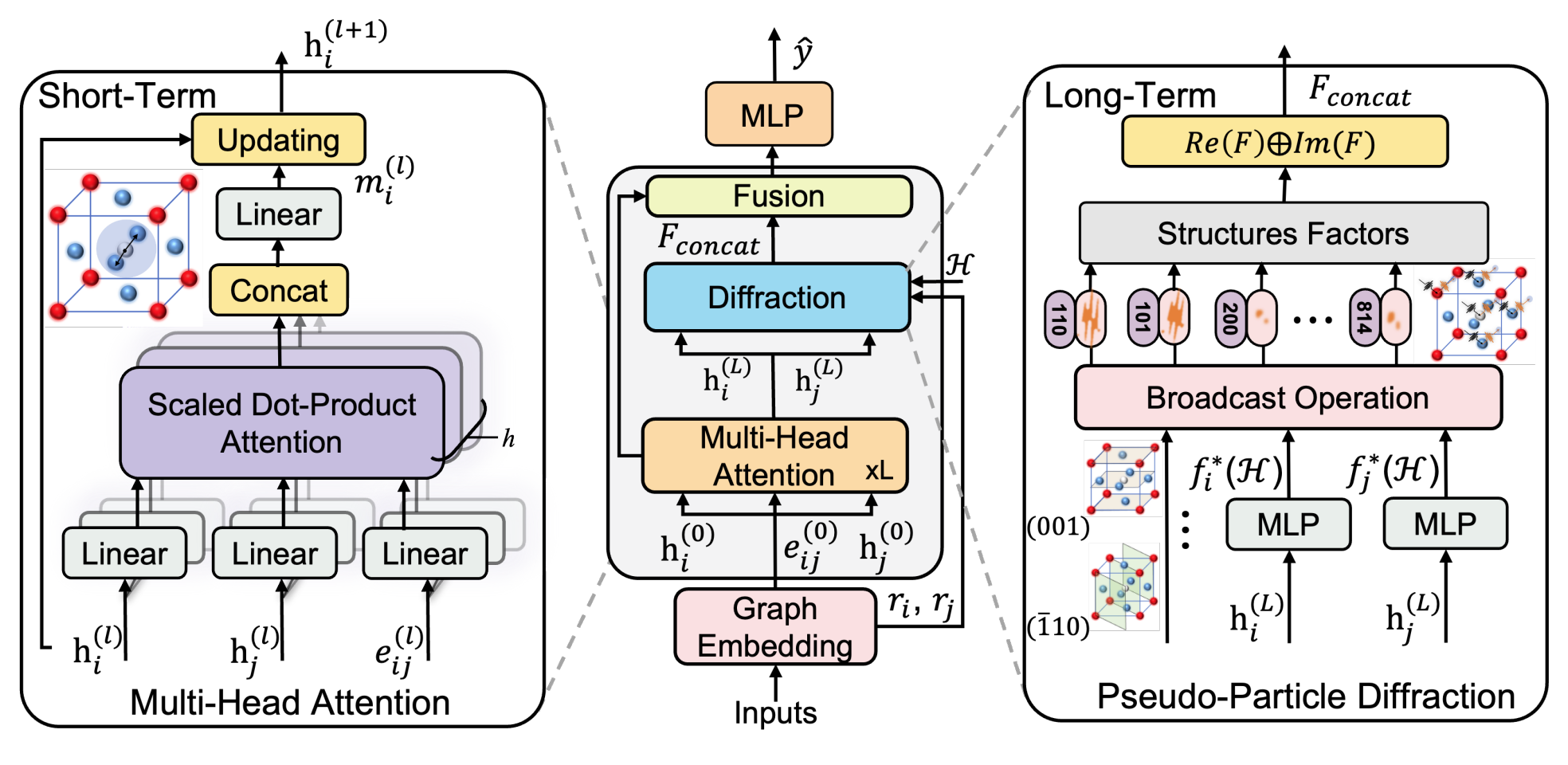
We propose PRDNet, a novel architecture that integrates graph embeddings with a learned pseudoparticle diffraction module. It generates synthetic diffraction patterns that are invariant to crystallographic symmetries. We extensively evaluate PRDNet on multiple large-scale benchmarks, including Materials Project, JARVIS-DFT, and MatBench. Our model achieves state-of-the-art performance across a wide range of crystal property prediction tasks, demonstrating its effectiveness.
Beyond Structure: Invariant Crystal Property Prediction with Pseudo-Particle Ray Diffraction
Cao Bin, Liu Yang#, Zhang Longhan, Wu Yifan, Luo Yuyu, Cheng Hong, Ren Yang#, Zhang Tongyi# (# corresponding author)
International Conference on Learning Representations (ICLR) 2026 Top tier AI conference
We propose PRDNet, a novel architecture that integrates graph embeddings with a learned pseudoparticle diffraction module. It generates synthetic diffraction patterns that are invariant to crystallographic symmetries. We extensively evaluate PRDNet on multiple large-scale benchmarks, including Materials Project, JARVIS-DFT, and MatBench. Our model achieves state-of-the-art performance across a wide range of crystal property prediction tasks, demonstrating its effectiveness.
Spatial-adaptive active learning identifies ultra-durable and highly active catalysts for acidic oxygen evolution reaction
Cao Bin*, Qin Yin#, Luo Yan*, Ying Zhehan, Yan Zilin, Weng Tu-Tao, Li Kaikai#, Zhang Tongyi# (* equal contribution, # corresponding author)
Science Bulletin 2026
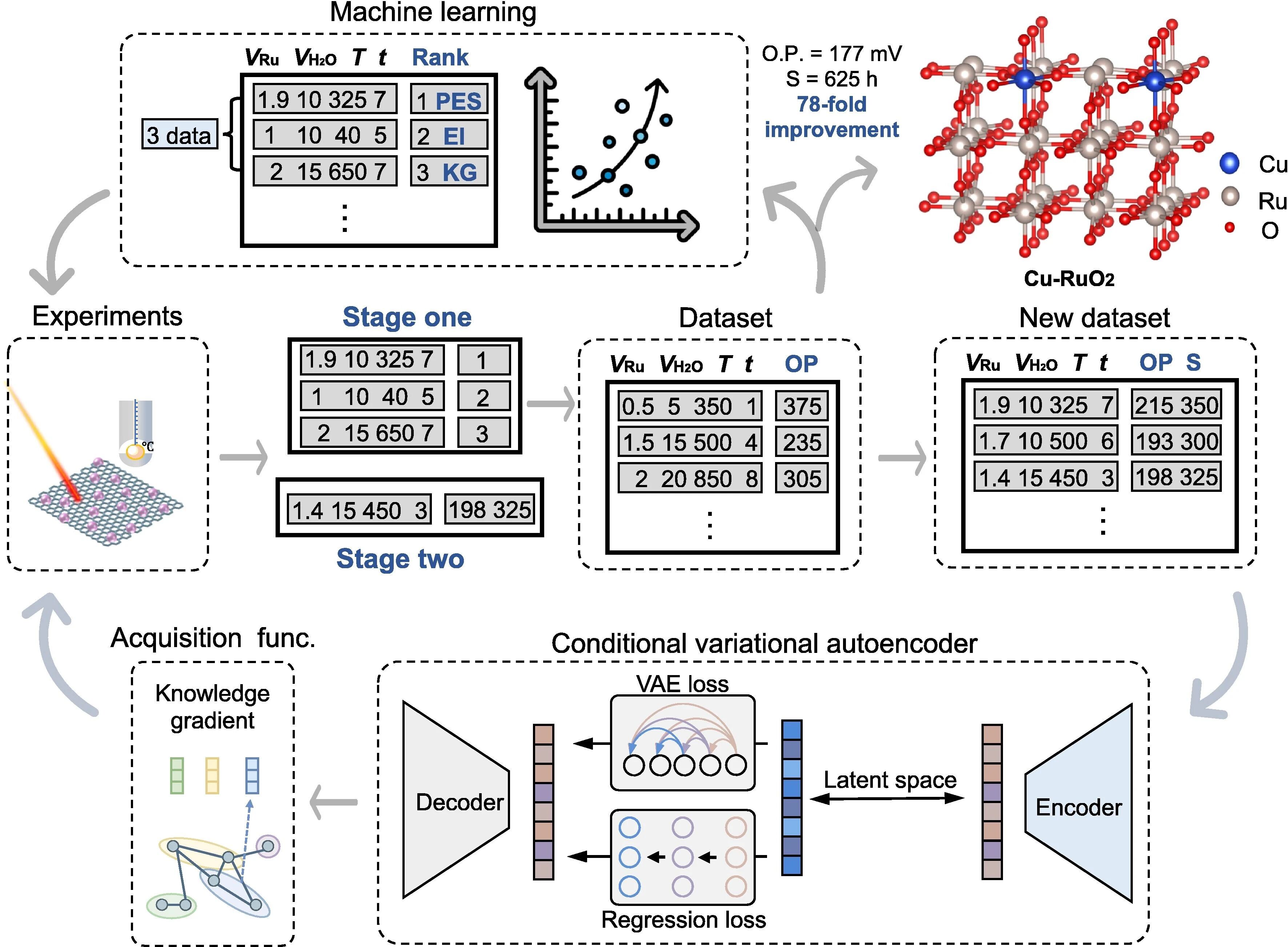
Here, we present a spatially adaptive active-learning framework with closed-loop experimentation for targeted catalyst optimization. Bayesian optimization and a conditional variational autoencoder first identify a low-overpotential stability subspace, followed by active learning to pinpoint the most stable candidate. This strategy leads to the discovery of a Cu–RuO₂ catalyst with outstanding durability (625 h) and a low overpotential of 177 mV at 10 mA cm⁻². Our results highlight an efficient AI-driven pathway for accelerating the design of stable acidic OER catalysts.
Spatial-adaptive active learning identifies ultra-durable and highly active catalysts for acidic oxygen evolution reaction
Cao Bin*, Qin Yin#, Luo Yan*, Ying Zhehan, Yan Zilin, Weng Tu-Tao, Li Kaikai#, Zhang Tongyi# (* equal contribution, # corresponding author)
Science Bulletin 2026
Here, we present a spatially adaptive active-learning framework with closed-loop experimentation for targeted catalyst optimization. Bayesian optimization and a conditional variational autoencoder first identify a low-overpotential stability subspace, followed by active learning to pinpoint the most stable candidate. This strategy leads to the discovery of a Cu–RuO₂ catalyst with outstanding durability (625 h) and a low overpotential of 177 mV at 10 mA cm⁻². Our results highlight an efficient AI-driven pathway for accelerating the design of stable acidic OER catalysts.
XQueryer: an intelligent crystal structure identifier for powder X-ray diffraction
Cao Bin, Zheng Zinan, Liu Yang, Zhang Longhan, Wong W-Y Lawrence, Weng Tu-Tao, Li Jia#, Li Haoxiang#, Zhang Tongyi# (# corresponding author)
National Science Review 2025
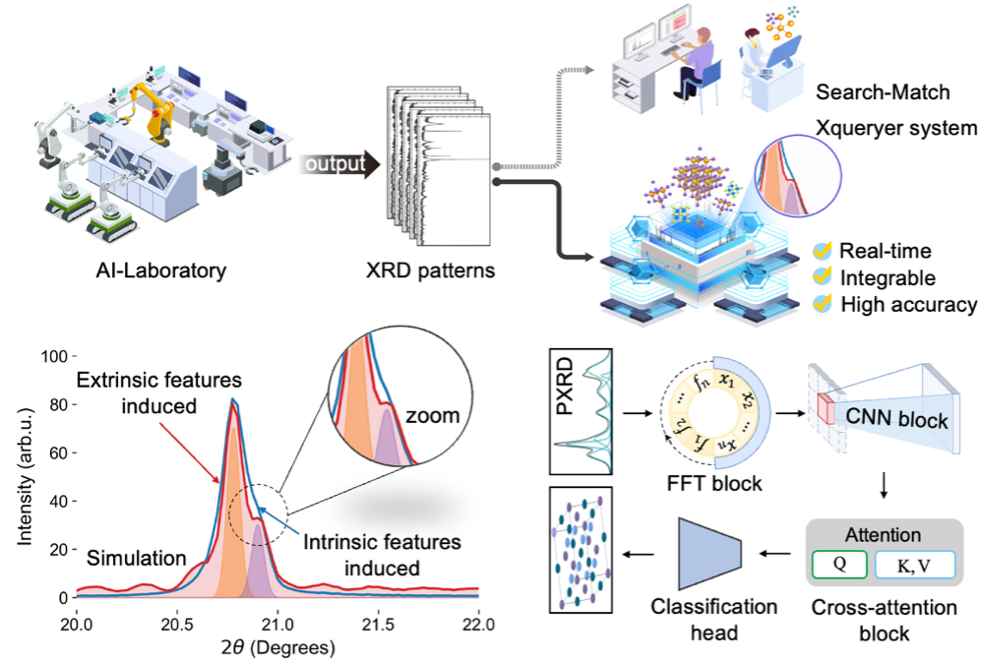
We developed XQueryer, an intelligent agent for simulating, recognizing, and analyzing powder X-ray diffraction (PXRD) patterns. Trained on over two million high-fidelity simulated spectra, XQueryer achieves significantly higher accuracy—28.9% better than existing AI models and traditional methods. Integrated with a powder diffractometer, it enables real-time structural analysis of crystal samples.
XQueryer: an intelligent crystal structure identifier for powder X-ray diffraction
Cao Bin, Zheng Zinan, Liu Yang, Zhang Longhan, Wong W-Y Lawrence, Weng Tu-Tao, Li Jia#, Li Haoxiang#, Zhang Tongyi# (# corresponding author)
National Science Review 2025
We developed XQueryer, an intelligent agent for simulating, recognizing, and analyzing powder X-ray diffraction (PXRD) patterns. Trained on over two million high-fidelity simulated spectra, XQueryer achieves significantly higher accuracy—28.9% better than existing AI models and traditional methods. Integrated with a powder diffractometer, it enables real-time structural analysis of crystal samples.
Optimize the quantum yield of G‐quartet‐based circularly polarized luminescence materials via active learning strategy‐BgoFace
Li Tianliang*, Chen Lifei*, Cao Bin*, Liu Siyuan, Lin Lixing, Li Zeyu, Chen Yingying, Li Zhenzhen, Zhang Tongyi#, Feng Linyan# (* equal contribution, # corresponding author)
MGE advances 2025
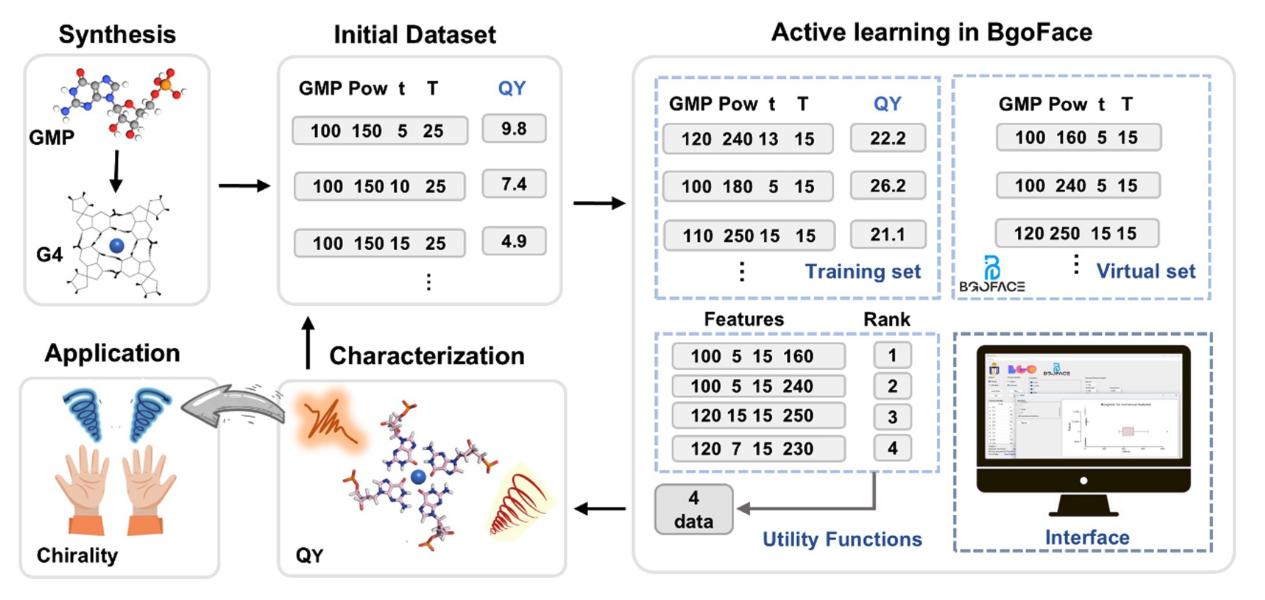
This work developed an integrated AL software, BgoFace, which satisfies most material property optimization re-quirements. The application of BgoFace (with default setting) successfully accel-erated the discovery of G4-based CPL materials, achievingresults within six iterations and synthesizing 24 experimentalgroups. The final QY nearly doubled the initial best QY inthe training dataset.
Optimize the quantum yield of G‐quartet‐based circularly polarized luminescence materials via active learning strategy‐BgoFace
Li Tianliang*, Chen Lifei*, Cao Bin*, Liu Siyuan, Lin Lixing, Li Zeyu, Chen Yingying, Li Zhenzhen, Zhang Tongyi#, Feng Linyan# (* equal contribution, # corresponding author)
MGE advances 2025
This work developed an integrated AL software, BgoFace, which satisfies most material property optimization re-quirements. The application of BgoFace (with default setting) successfully accel-erated the discovery of G4-based CPL materials, achievingresults within six iterations and synthesizing 24 experimentalgroups. The final QY nearly doubled the initial best QY inthe training dataset.
Materials Generation in the Era of Artificial Intelligence: A Comprehensive Survey
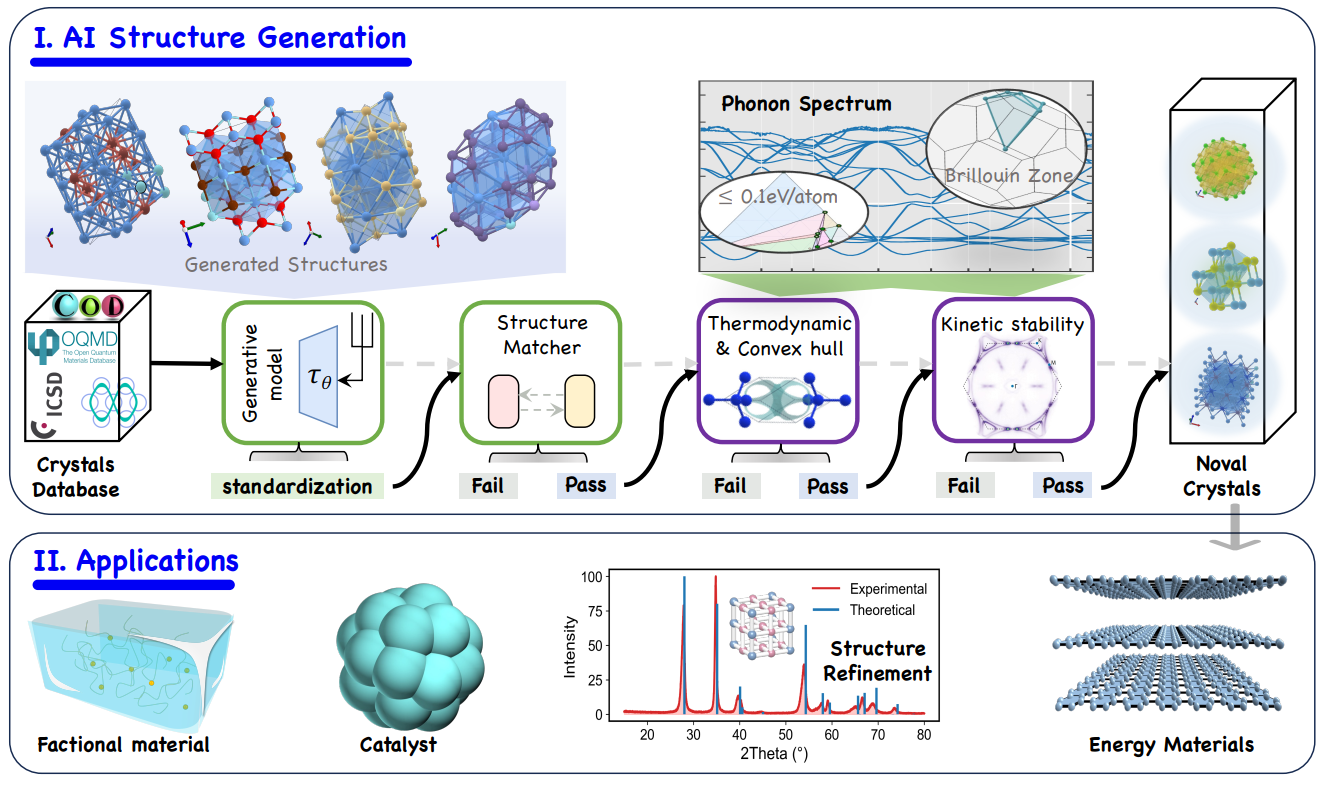
Li Zhixun*, Cao Bin*, Jiao Rui*, Wang Liang*, Wang Ding, Liu Yang, Chen Dingshuo, Li Jia, Liu Yu, Wang Liang, Zhang Tongyi, Yu Xu Jeffrey (* equal contribution)
arXiv 2025
We first organize various types of materials and illustrate multiple representations of crystalline materials. We then provide a detailed summary and taxonomy of current AI-driven materials generation approaches. Furthermore, we discuss the common evaluation metrics and summarize open-source codes and benchmark datasets. Finally, we conclude with potential future directions and challenges in this fast-growing field.
Materials Generation in the Era of Artificial Intelligence: A Comprehensive Survey
Li Zhixun*, Cao Bin*, Jiao Rui*, Wang Liang*, Wang Ding, Liu Yang, Chen Dingshuo, Li Jia, Liu Yu, Wang Liang, Zhang Tongyi, Yu Xu Jeffrey (* equal contribution)
arXiv 2025
We first organize various types of materials and illustrate multiple representations of crystalline materials. We then provide a detailed summary and taxonomy of current AI-driven materials generation approaches. Furthermore, we discuss the common evaluation metrics and summarize open-source codes and benchmark datasets. Finally, we conclude with potential future directions and challenges in this fast-growing field.
Interpretable Active Learning Identifies Iron-Doped Carbon Dots With High Photothermal Conversion Efficiency for Antitumor Synergistic Therapy
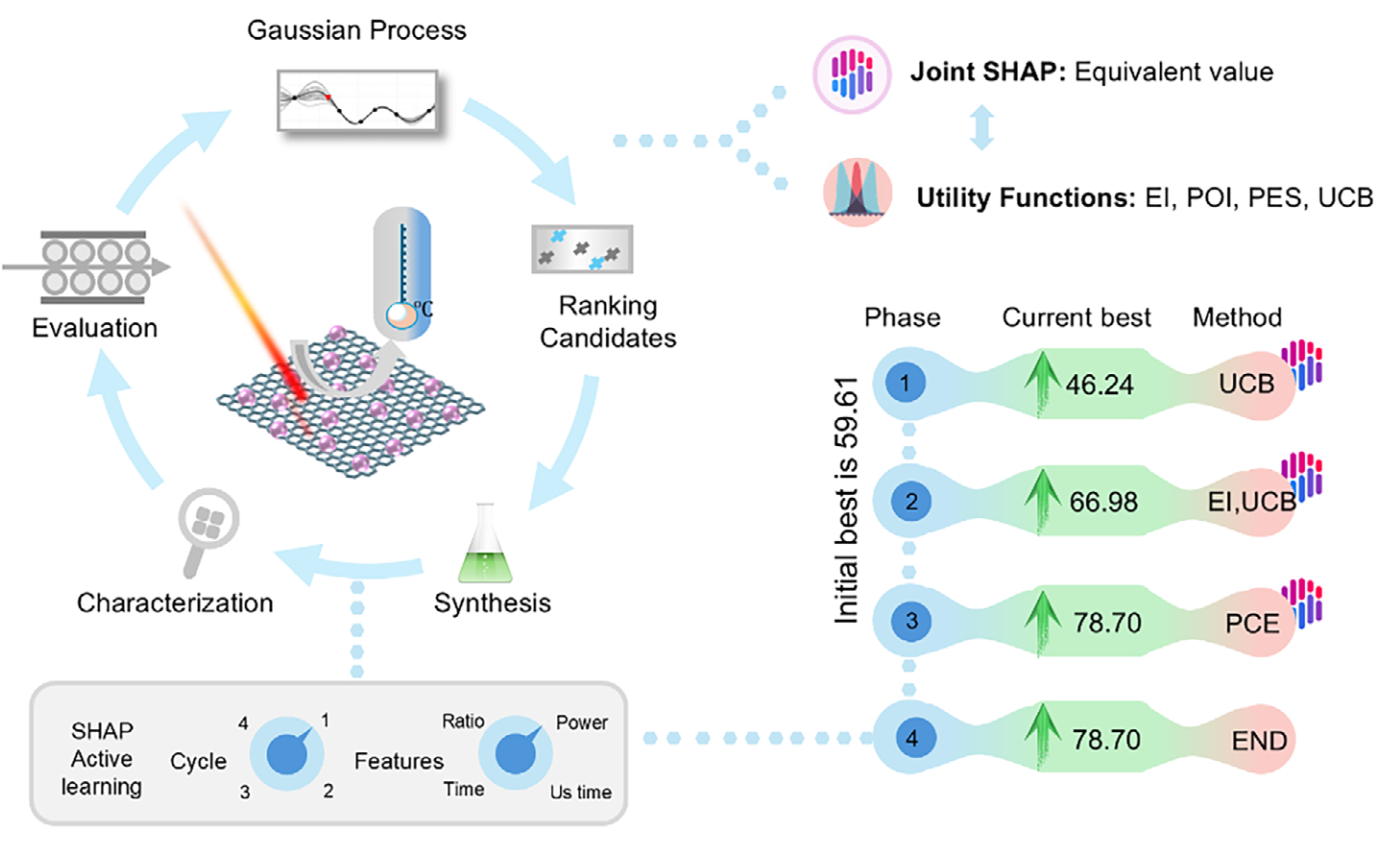
Li Tianliang*, Cao Bin*, Wang Yitong, Lin Lixing, Chen Lifei, Su Tianhao, Song Haicheng, Ren Yuze, Zhang Longhan, Chen Yingying, Li Zhenzhen, Feng Linyan#, Zhang Tongyi# (* equal contribution, # corresponding author)
Aggregate 2025
We apply an interpretable AL strategy to efficiently optimize the photothermal conversion efficiency (PCE) of carbon dots (CDs) in photothermal therapy (PTT). Using this approach, we successfully synthesized irondoped CDs (Fe-CDs) with PCE exceeding 78.7% after only 16 experimental trials over four iterations.
Interpretable Active Learning Identifies Iron-Doped Carbon Dots With High Photothermal Conversion Efficiency for Antitumor Synergistic Therapy
Li Tianliang*, Cao Bin*, Wang Yitong, Lin Lixing, Chen Lifei, Su Tianhao, Song Haicheng, Ren Yuze, Zhang Longhan, Chen Yingying, Li Zhenzhen, Feng Linyan#, Zhang Tongyi# (* equal contribution, # corresponding author)
Aggregate 2025
We apply an interpretable AL strategy to efficiently optimize the photothermal conversion efficiency (PCE) of carbon dots (CDs) in photothermal therapy (PTT). Using this approach, we successfully synthesized irondoped CDs (Fe-CDs) with PCE exceeding 78.7% after only 16 experimental trials over four iterations.
SimXRD-4M: Big Simulated X-ray Diffraction Data and Crystal Symmetry Classification Benchmark
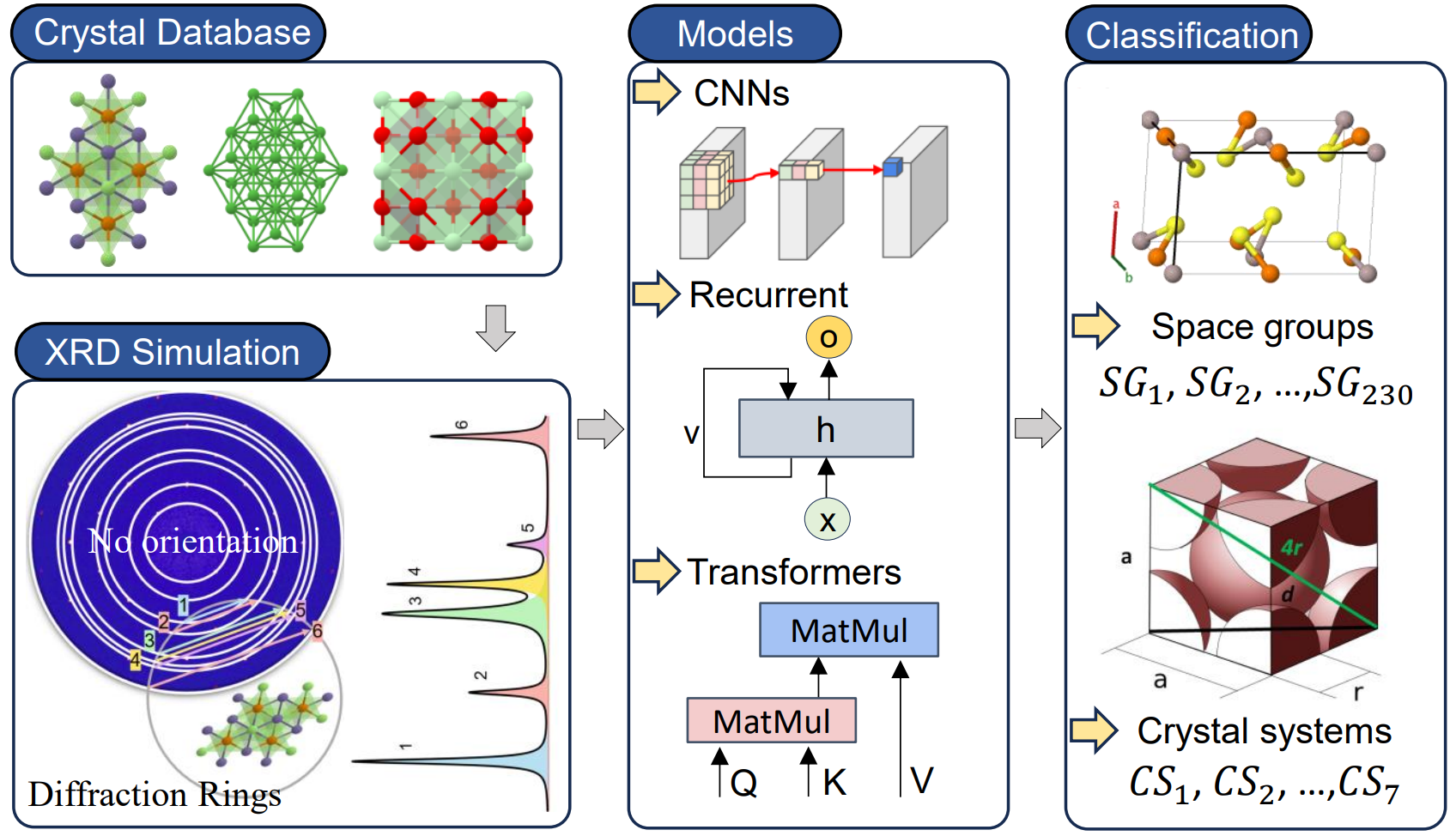
Cao Bin*, Liu Yang*, Zheng Zinan*, Tan Ruifeng, Li Jia#, Zhang Tongyi# (* equal contribution, # corresponding author)
International Conference on Learning Representations (ICLR) 2025 Top tier AI conference
We developed a novel XRD simulation method that incorporates comprehensive physical interactions, resulting in a high-fidelity database. SimXRD comprises 4,065,346 simulated powder XRD patterns, representing 119,569 unique crystal structures under 33 simulated conditions that reflect real-world variations. We benchmark 21 sequence models in both in-library and out-of-library scenarios and analyze the impact of class imbalance in longtailed crystal label distributions. Remarkably, we find that: (1) current neural networks struggle with classifying low-frequency crystals, particularly in out-oflibrary situations; (2) models trained on SimXRD can generalize to real experimental data.
SimXRD-4M: Big Simulated X-ray Diffraction Data and Crystal Symmetry Classification Benchmark
Cao Bin*, Liu Yang*, Zheng Zinan*, Tan Ruifeng, Li Jia#, Zhang Tongyi# (* equal contribution, # corresponding author)
International Conference on Learning Representations (ICLR) 2025 Top tier AI conference
We developed a novel XRD simulation method that incorporates comprehensive physical interactions, resulting in a high-fidelity database. SimXRD comprises 4,065,346 simulated powder XRD patterns, representing 119,569 unique crystal structures under 33 simulated conditions that reflect real-world variations. We benchmark 21 sequence models in both in-library and out-of-library scenarios and analyze the impact of class imbalance in longtailed crystal label distributions. Remarkably, we find that: (1) current neural networks struggle with classifying low-frequency crystals, particularly in out-oflibrary situations; (2) models trained on SimXRD can generalize to real experimental data.
Machine Learning-Engineered Nanozyme System for Synergistic Anti-Tumor Ferroptosis/Apoptosis Therapy
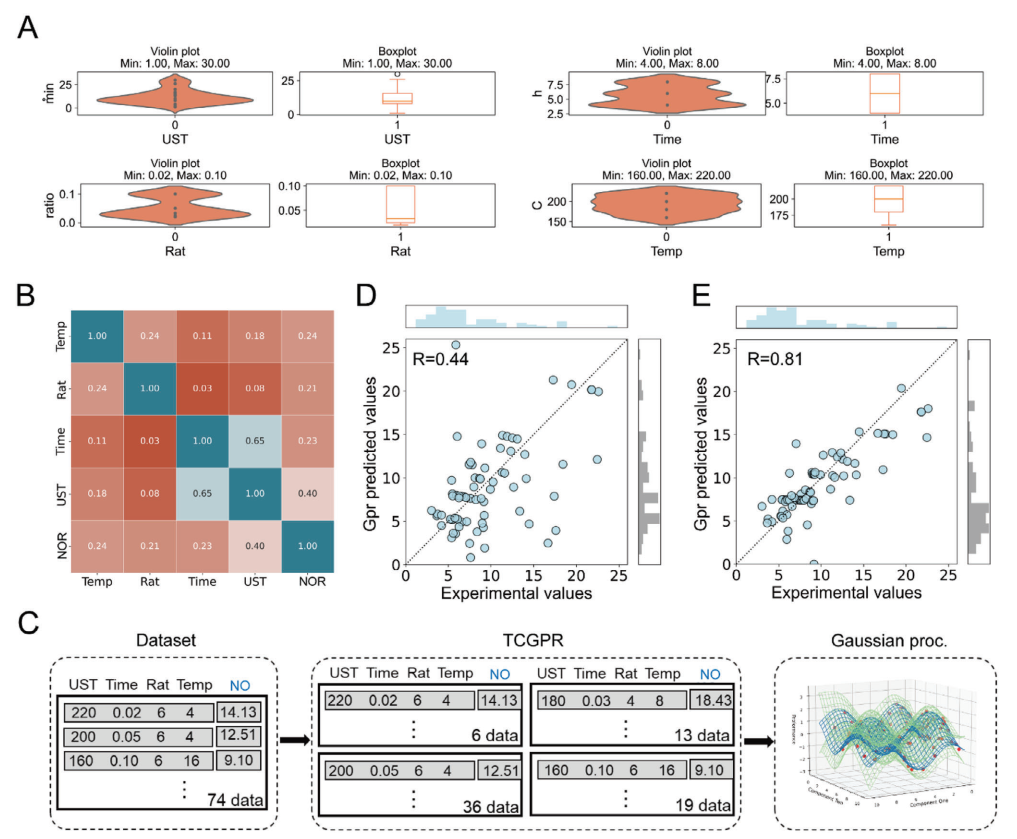
Li Tianliang*, Cao Bin*, Su Tianhao*, Lin Lixing, Wang Dong, Liu Xinting, Wan haoyu, Ji Haiwei, He Zixuan, Chen Yingying, Feng Lingyan#, Zhang Tongyi (* equal contribution, # corresponding author)
Small 2024
A novel ML model, termed the sequential backward Tree-Classifier for Gaussian Process Regression (TCGPR), is proposed to improve data pattern recognition following the divide-and-conquer principle.
Machine Learning-Engineered Nanozyme System for Synergistic Anti-Tumor Ferroptosis/Apoptosis Therapy
Li Tianliang*, Cao Bin*, Su Tianhao*, Lin Lixing, Wang Dong, Liu Xinting, Wan haoyu, Ji Haiwei, He Zixuan, Chen Yingying, Feng Lingyan#, Zhang Tongyi (* equal contribution, # corresponding author)
Small 2024
A novel ML model, termed the sequential backward Tree-Classifier for Gaussian Process Regression (TCGPR), is proposed to improve data pattern recognition following the divide-and-conquer principle.
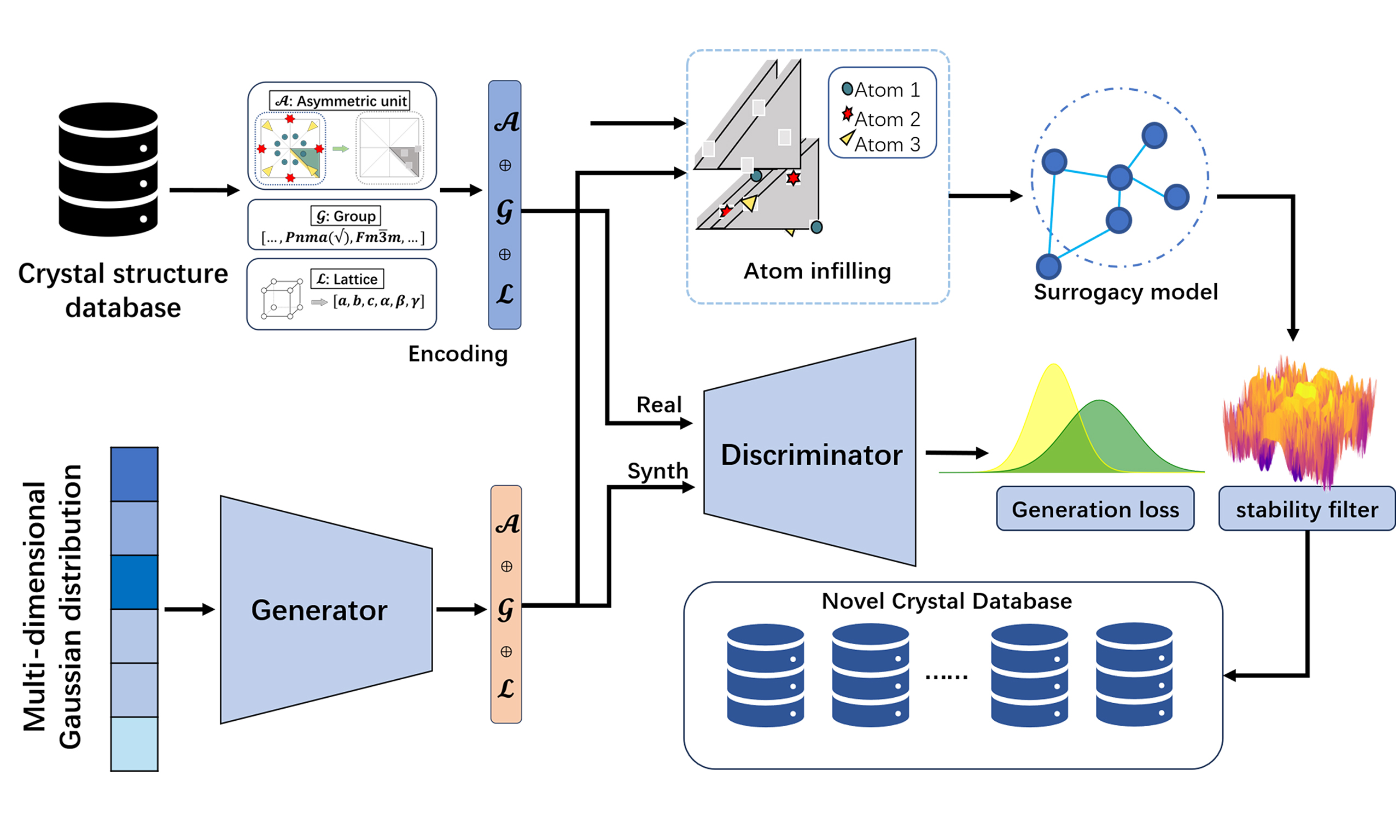
CGWGAN: crystal generative framework based on Wyckoff generative adversarial network
Su Tianhao*, Cao Bin*, Hu Shunbo, Li Musen, Zhang Tongyi# (* equal contribution, # corresponding author)
journal of material informatics 2024
In this work, we present a crystal generative framework based on Wyckoff generative adversarial network (CGWGAN) to efficiently discover novel crystals.
CGWGAN: crystal generative framework based on Wyckoff generative adversarial network
Su Tianhao*, Cao Bin*, Hu Shunbo, Li Musen, Zhang Tongyi# (* equal contribution, # corresponding author)
journal of material informatics 2024
In this work, we present a crystal generative framework based on Wyckoff generative adversarial network (CGWGAN) to efficiently discover novel crystals.
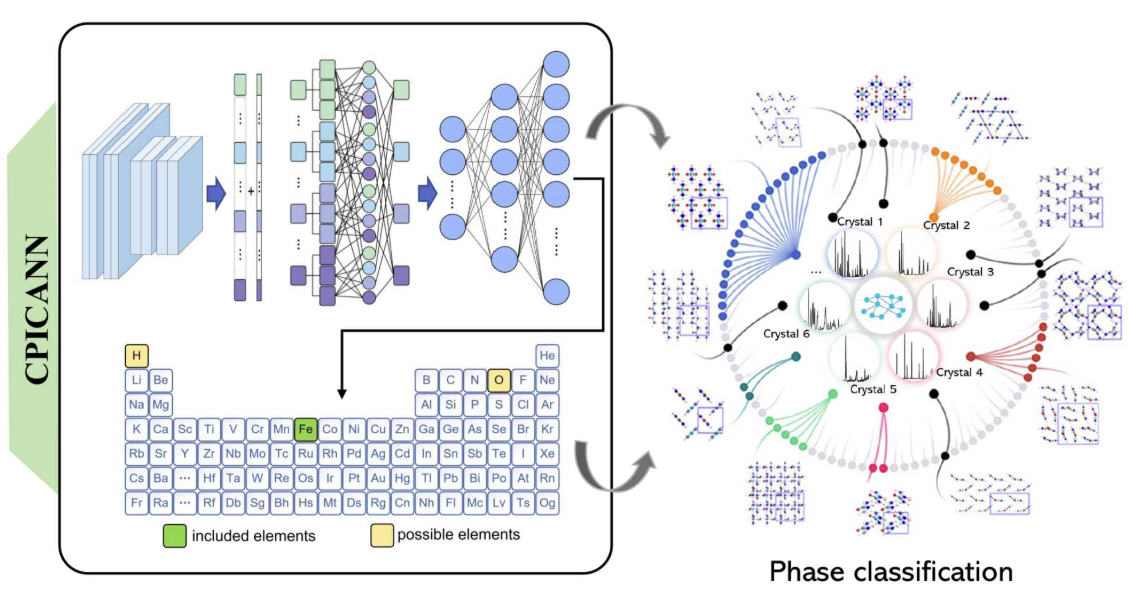
Crystallographic Phase Identifier of a Convolutional Self-Attention Neural Network (CPICANN) on Powder Diffraction Patterns
Zhang Shouyang*, Cao Bin*, Su Tianhao, Wu Yue, Feng Zhenjie, Xiong Jie#, Zhang Tongyi# (* equal contribution, # corresponding author)
IUCrJ 2024
In this work, we developed a machine learning phase identifier that achieved excellent performance for structure identification from powder diffraction patterns.
Crystallographic Phase Identifier of a Convolutional Self-Attention Neural Network (CPICANN) on Powder Diffraction Patterns
Zhang Shouyang*, Cao Bin*, Su Tianhao, Wu Yue, Feng Zhenjie, Xiong Jie#, Zhang Tongyi# (* equal contribution, # corresponding author)
IUCrJ 2024
In this work, we developed a machine learning phase identifier that achieved excellent performance for structure identification from powder diffraction patterns.
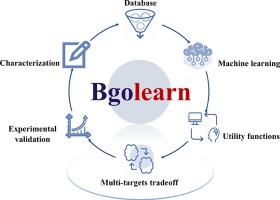
Active Learning Accelerates the Discovery of High Strength and High Ductility Lead-Free Solder Alloys
Cao Bin, Su Tianhao, Yv Shuting, Li Tianyuan, Zhang Taolue, Dong Ziqiang#, Zhang Tongyi# (# corresponding author)
Materials & Design 2024
To facilitate materials informatics development, all active learning algorithms were made open-source in our designed framework, Bgolearn
Active Learning Accelerates the Discovery of High Strength and High Ductility Lead-Free Solder Alloys
Cao Bin, Su Tianhao, Yv Shuting, Li Tianyuan, Zhang Taolue, Dong Ziqiang#, Zhang Tongyi# (# corresponding author)
Materials & Design 2024
To facilitate materials informatics development, all active learning algorithms were made open-source in our designed framework, Bgolearn
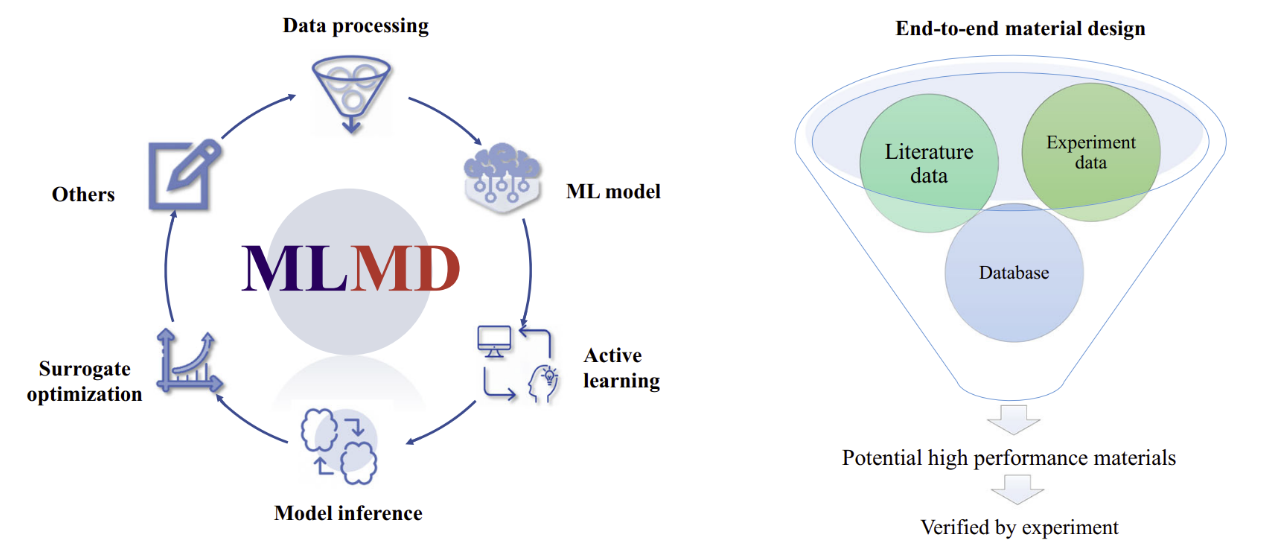
MLMD: a programming-free AI platform to predict and design materials
Ma Jiaxuan*, Cao Bin*, Dong Shuya, Tian Yuan, Wang Menghuan, Xiong Jie#, Sun Sheng# (* equal contribution, # corresponding author)
npj Computational Materials 2024
We developed MLMD, an AI platform for materials design. It is capable of effectively discovering novel materials with high-potential advanced properties end-to-end, utilizing model inference, surrogate optimization, and even working in situations of data scarcity based on active learning.
MLMD: a programming-free AI platform to predict and design materials
Ma Jiaxuan*, Cao Bin*, Dong Shuya, Tian Yuan, Wang Menghuan, Xiong Jie#, Sun Sheng# (* equal contribution, # corresponding author)
npj Computational Materials 2024
We developed MLMD, an AI platform for materials design. It is capable of effectively discovering novel materials with high-potential advanced properties end-to-end, utilizing model inference, surrogate optimization, and even working in situations of data scarcity based on active learning.
Divide and conquer: Machine learning accelerated design of lead-free solder alloys with high strength and high ductility
Wei Qinghua*, Cao Bin*, Yuan Hao*, Chen Youyang, You Kangdong, Yv Shuting, Yang Tixin, Dong Ziqiang#, Zhang Tongyi# (* equal contribution, # corresponding author)
npj Computational Materials 2023
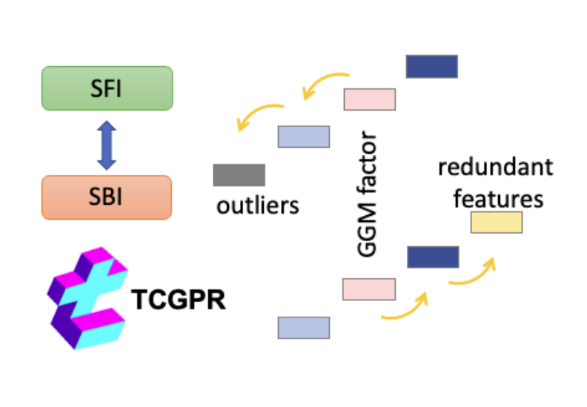
In general, small in size and big in noise, while the design space is huge, by a newly developed data preprocessing algorithm, named the Tree-Classifier for Gaussian Process Regression (TCGPR)….
Divide and conquer: Machine learning accelerated design of lead-free solder alloys with high strength and high ductility
Wei Qinghua*, Cao Bin*, Yuan Hao*, Chen Youyang, You Kangdong, Yv Shuting, Yang Tixin, Dong Ziqiang#, Zhang Tongyi# (* equal contribution, # corresponding author)
npj Computational Materials 2023
In general, small in size and big in noise, while the design space is huge, by a newly developed data preprocessing algorithm, named the Tree-Classifier for Gaussian Process Regression (TCGPR)….
Domain knowledge-guided interpretive machine learning: formula discovery for the oxidation behavior of ferritic-martensitic steels in supercritical water
Cao Bin, Yang Shuang, Sun Ankang, Dong Ziqing#, Zhang Tongyi# (# corresponding author)
journal of material informatics 2022 Cover Paper & 2024 Best Paper Award
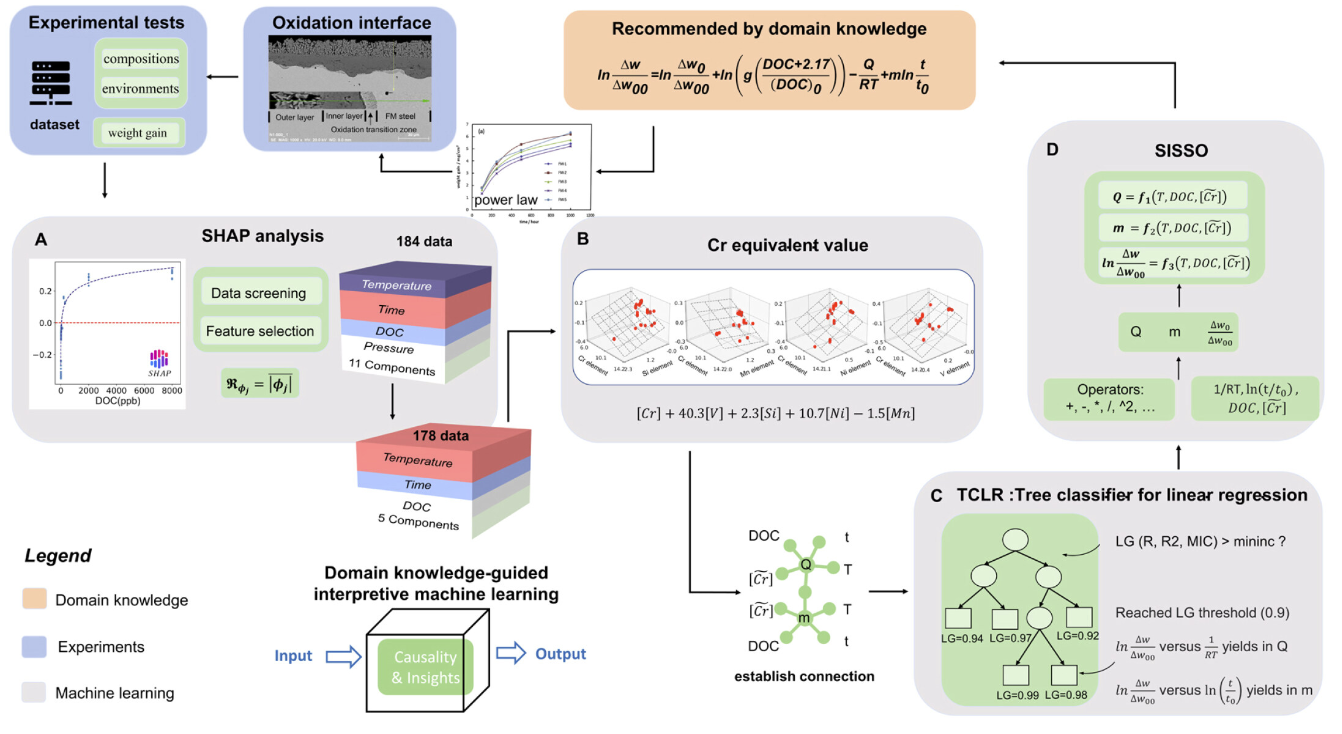
In this study, we propose a domain knowledge-guided interpretive machine learning strategy and demonstrate it by studying the oxidation behavior of ferritic-martensitic steels in supercritical water…
Domain knowledge-guided interpretive machine learning: formula discovery for the oxidation behavior of ferritic-martensitic steels in supercritical water
Cao Bin, Yang Shuang, Sun Ankang, Dong Ziqing#, Zhang Tongyi# (# corresponding author)
journal of material informatics 2022 Cover Paper & 2024 Best Paper Award
In this study, we propose a domain knowledge-guided interpretive machine learning strategy and demonstrate it by studying the oxidation behavior of ferritic-martensitic steels in supercritical water…